If you work in tech (or just hop on LinkedIn occasionally), you’ve likely heard of AI Agents.
When people think about AI in the workplace, they’re usually thinking about ChatGPT helping them write emails or summarize documents. But there’s a bigger shift happening, one that’s moving us beyond reactive AI tools toward autonomous agents that can actually get work done without you having to manage every step of the process.
As someone who has been experimenting with AI agents at work and watching the space evolve rapidly, I’m convinced the technology is starting to mature beyond pilot projects. The companies that figure out how to deploy these systems effectively will have a massive productivity advantage, especially in data-heavy workflows where repetitive tasks eat up huge chunks of every data practitioner’s time.
In this blog, we’ll explore what AI Agents are, share some examples of agents at work at phData, and give you some pointers on how to get started implementing them at your company.
What Are AI Agents, Really?
Think of AI agents like FRIDAY from the Iron Man movies. Instead of just answering Tony Stark’s questions, FRIDAY can monitor systems, analyze threats, and take action autonomously while he focuses on the big picture. That’s the natural evolution we’re seeing from Large Language Models (LLMs).
Where ChatGPT responds to your prompts, agents can perceive what’s happening in your environment, make decisions about what to do next, and actually take action to complete multi-step tasks (see diagram below). They’re autonomous systems that can work toward goals without you micromanaging every step.
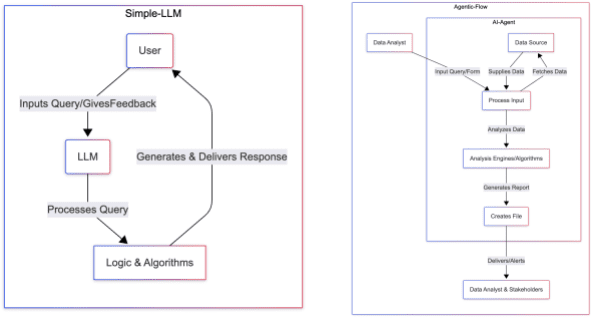
The key difference is agency, the ability to act independently. Instead of asking an AI, ‘Can you help me analyze this data?’ and then feeding it information piece by piece, you can tell an agent, ‘Monitor these dashboards and alert me when anomalies appear’, and it will continuously watch, analyze, and notify you without further input.
This shift from reactive assistance to proactive automation is what makes agents particularly powerful for data teams.
Data engineers, analysts, and scientists spend so much time on routine tasks, checking for data quality issues, updating reports, and gathering information from multiple sources, all of which could be handled autonomously while they focus on the strategic analysis that actually drives business value.
Experimenting with AI Agents in the Real World
Over the past few months, I’ve built a couple of agents to solve my own productivity pain points, and the results have been eye-opening.
The 'FOMO Fixer' Agent
Anyone who works remotely knows the feeling of coming back from vacation (or even a long weekend) to hundreds of Slack messages, dozens of emails, and shared docs with weeks of updates. I built an agent that scans through all of this (Slack channels, Gmail, Google Docs) that have been shared with me and creates a prioritized summary of what I actually need to know.
It doesn’t just dump everything into a list. The agent looks for action items directed at me, decisions that affect my work, and updates on projects I’m involved in.
The time savings were real.
What used to take me an hour of scrolling and catching up now takes five minutes to read a focused summary.
The Certification Prep Agent
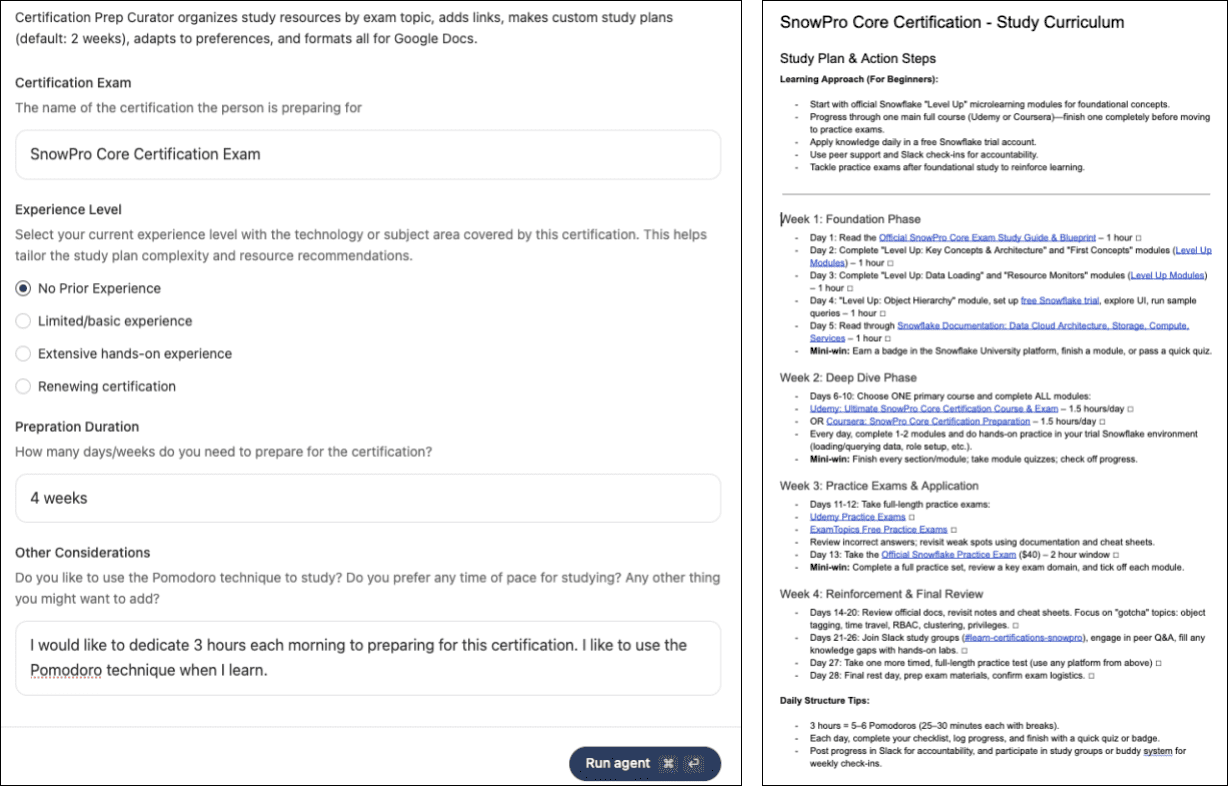
When I was preparing for a certification recently, I built an agent that analyzes exam objectives and builds personalized learning curricula. You feed it the parameters about the certification requirements, and it creates a study plan, finds relevant resources, and generates a self-paced learning schedule for you.
This planning and curating moves beyond the capabilities of an LLM, leveraging model context protocols to dynamically adapt and refine the learning path by adjusting various parameters. Unlike an LLM that requires step-by-step guidance, the AI agent autonomously makes decisions and acts on goals, delivering a truly proactive and efficient solution.
The time savings matter, but the real win is how much more effectively I can prepare. Employees at phData are encouraged to pursue certifications in high-level areas, and this agent can help eliminate that ‘Where do I even start?’ moment.
Both of these experiments taught me something important: the real value is solving specific, well-defined problems with measurable outcomes. And you need to evaluate and iterate constantly. What looks like it’s working might actually be creating new problems if you’re not careful about measurement.
How are Companies Using AI Agents?
While I’ve been experimenting with small personal use cases, major tech companies are betting big on agents for enterprise applications. The scale and investment here should tell you something about where this is heading.
Amazon isn’t just dabbling in agents; they’re going all-in. In March 2025, AWS formed an entirely new business unit focused on Agentic AI, with CEO Matt Garman stating that ‘Agentic AI has the potential to be the next multi-billion-dollar business for AWS.’ Their Amazon Bedrock platform now offers inline agents that can ‘dynamically adjust your agent’s behavior at runtime by changing its instructions, tools, guardrails, knowledge bases, prompts, and even the FMs it uses, all without redeploying your application.’
Meanwhile, Salesforce has seen immediate traction with its Agentforce platform, closing over 1,000 deals since launching in October 2024. Companies like Wiley are seeing ‘more than 40% increase in case resolution with Agentforce, outperforming their old bot.’
Microsoft is taking a different approach with multi-agent systems, where multiple specialized agents work together. So far, over 230,000 organizations are already using Copilot Studio, with real-world examples like T-Mobile’s agent that ‘connects to more than 20 device manufacturers’ websites, instantly assembling product information’ while HCLTech’s agent ‘streamlines employee support, resolving cases 40% faster.’
These aren’t pilot projects; they’re production systems that deliver measurable business value.
AI Agent Automation Opportunities for Data Teams
Looking at where agents are succeeding in production, I see two immediate opportunities for data teams to get started.
Browserless Automation for Data Collection
Traditional web scraping and data collection often require managing browser infrastructure, dealing with bot detection, and handling all the operational complexity of keeping systems running. Browserless automation platforms are changing this by providing managed services that handle the infrastructure while agents handle the intelligence.
Companies like Browserless.io have reached $1.3M in revenue and serve 3,000 customers by providing web scraping and form automation without the traditional browser overhead. For data teams, this means agents can collect data from websites, fill out forms, and monitor sources automatically without the usual technical debt.
Think about use cases like monitoring competitor pricing, collecting regulatory filings, or gathering market data from multiple sources. Agents can handle not just the collection but the cleaning, validation, and routing of that data to the right systems.
Automated Data Insights and Reporting
The bigger opportunity is in automating the analysis and communication of insights. Microsoft customers are already seeing dramatic results here.
Lumen uses AI agents to ‘summarize past sales interactions, as well as generate recent news, business challenges, broader industry trends, insights and recommendations,’ cutting preparation time from 4 hours to 15 minutes. Aberdeen City Council projects ‘a 241% ROI in time savings and improved productivity, saving an estimated $3 million annually’ using AI agents for automated reporting.
For data teams, this translates to agents that can monitor KPIs, detect anomalies, generate executive summaries, and even create presentations with insights and recommendations. Instead of spending hours each week creating status reports, agents can continuously monitor your data and surface insights when they matter.
Building the Future of Data Intelligence
At phData, we’re not just watching the agent revolution from the sidelines; we’re actively building it into how we solve our clients’ toughest data challenges. After helping thousands of organizations modernize their data stacks, we’ve seen firsthand where automation can transform productivity, and agents represent the next logical evolution.
Our experience with evaluation-driven development and vendor-specific modeling approaches puts us in a unique position to help organizations deploy agents effectively. We understand that successful agent implementations aren’t about the flashiest technology; they’re about solving specific business problems with measurable outcomes. Whether it’s automating data quality monitoring, streamlining report generation, or creating intelligent data discovery systems, we’re helping clients identify where agents can deliver real ROI.
The same principles that guide our approach to building robust data platforms apply to agent development: start with clear objectives, build in evaluation frameworks from day one, and scale based on proven value. As the technology matures, we’re excited to help organizations navigate this transition thoughtfully, avoiding the common pitfalls while capturing the genuine productivity gains that well-implemented agents can provide.
Getting Started: Lessons from the Field
Based on my experiments and what I’m seeing in production deployments, here’s how to approach building agents for your data workflows:
Start Small and Specific: Don’t try to build the ultimate AI assistant. Pick one repetitive task that has clear inputs, outputs, and success criteria. My Slack summarizer works because ‘catch me up on what I missed’ is a well-defined problem with measurable value.
Build Evaluation from Day One: This is crucial and often overlooked. How will you know if your agent is actually helping or just creating new problems? Set up metrics and feedback loops before you deploy anything. This requires intentional test cases and frameworks for evaluating agents. (Blog on Evaluating AI Agents coming soon!)
Consider Your Data Complexity: Just like choosing between vendor-specific models and generic approaches in machine learning, agent architecture matters. If you’re dealing with complex, domain-specific data patterns, specialized agents will likely outperform general-purpose ones.
Scale Based on Measurable Success: Don’t expand to new use cases until you’ve proven value in your initial deployment. The companies seeing real ROI from agents are the ones that started with focused pilots and scaled based on concrete results.
The Road Ahead
We’re still in the early days of the agent revolution, but the trajectory is clear. The companies that figure out how to effectively deploy autonomous agents will have a significant competitive advantage, especially in data-intensive work where the potential for automation is enormous.
For data teams, this represents both an opportunity and a responsibility. We understand the workflows, the pain points, and the metrics that matter. We’re uniquely positioned to lead this transformation within our organizations.
The question isn’t whether AI agents will reshape how we work with data; it’s whether we’ll be the ones shaping that future or just reacting to it.

Don't know where to start?
If you’re looking to start building AI Agents but don’t have a solid plan or idea of where to start, attend one of our Free Generative AI Workshops for advice, direction, and help.