

A very interesting and productive way to use Artificial Intelligence is to create agents to act as SMEs (Subject Matter Experts). Consultants and technology experts often encounter previously unaddressed technical challenges, often very specific ones.
As humans, we may not retain all the knowledge necessary to solve these problems without consulting other tools/libraries. Given this need, why not use SME agents to facilitate this search for knowledge and problem-solving quickly, simply, and objectively?
What are Agents in Artificial Intelligence?
First, let’s clarify some concepts that have similar names but very different definitions and applications, and which many people confuse: Agentic AI and AI agents.
We can classify AI agents as individual programs that perform very specific tasks according to planned and programmed parameters. We can consider them a type of specialized worker, focusing on specific tasks, such as the famous chatbots. In general, they are programs that interact with users in order to respond with automated interactions, typically associated with automation and recommendations.
Obviously, these agents can understand the environment in which they operate, but their decision-making capacity and autonomy of action are quite limited. In short, these agents are very good at specific tasks but operate in a kind of bubble, possessing very limited and restricted environmental knowledge, lacking a comprehensive understanding of the larger context in which they operate. Consequently, they lack a great capacity for adapting their behavior and results.
On the other hand, Agentic AI is currently considered the highest level of AI evolution, notably featuring autonomous behavior and environmental understanding that goes beyond simply executing specific tasks.
They have the ability to utilize a variety of different resources such as LLMs, databases, websites, and static files. With this variety, they can analyze data sources, plan activities effectively, complete tasks, and deliver results aligned with the established goals.
Goal-oriented behavior programming combined with complex reasoning capabilities allows for a greater understanding of the environment and operations to achieve ultimate goals.
Agents can be considered autonomous orchestrators of business processes that can understand the implications of their actions broadly and adjust their strategies appropriately according to the current scenario.
What is Glean and How Does it Work?
Glean is a strong enterprise AI platform that analyzes your company’s data to provide citation-backed answers and insights. When deployed, Glean becomes an expert who reviews every document and participates in every conversation at your organization.
It allows corporate search across your internal systems by indexing content via native and custom connectors and then building an understanding of that information, allowing you to find what you’re looking for in one spot. It integrates several enterprise data sources, including documents, messages, tickets, and code, into a single, permission-aware index.
Most importantly, Glean replicates source permissions. Users only see results that they already have access to in the originating apps, and those access rules are enforced during query time.
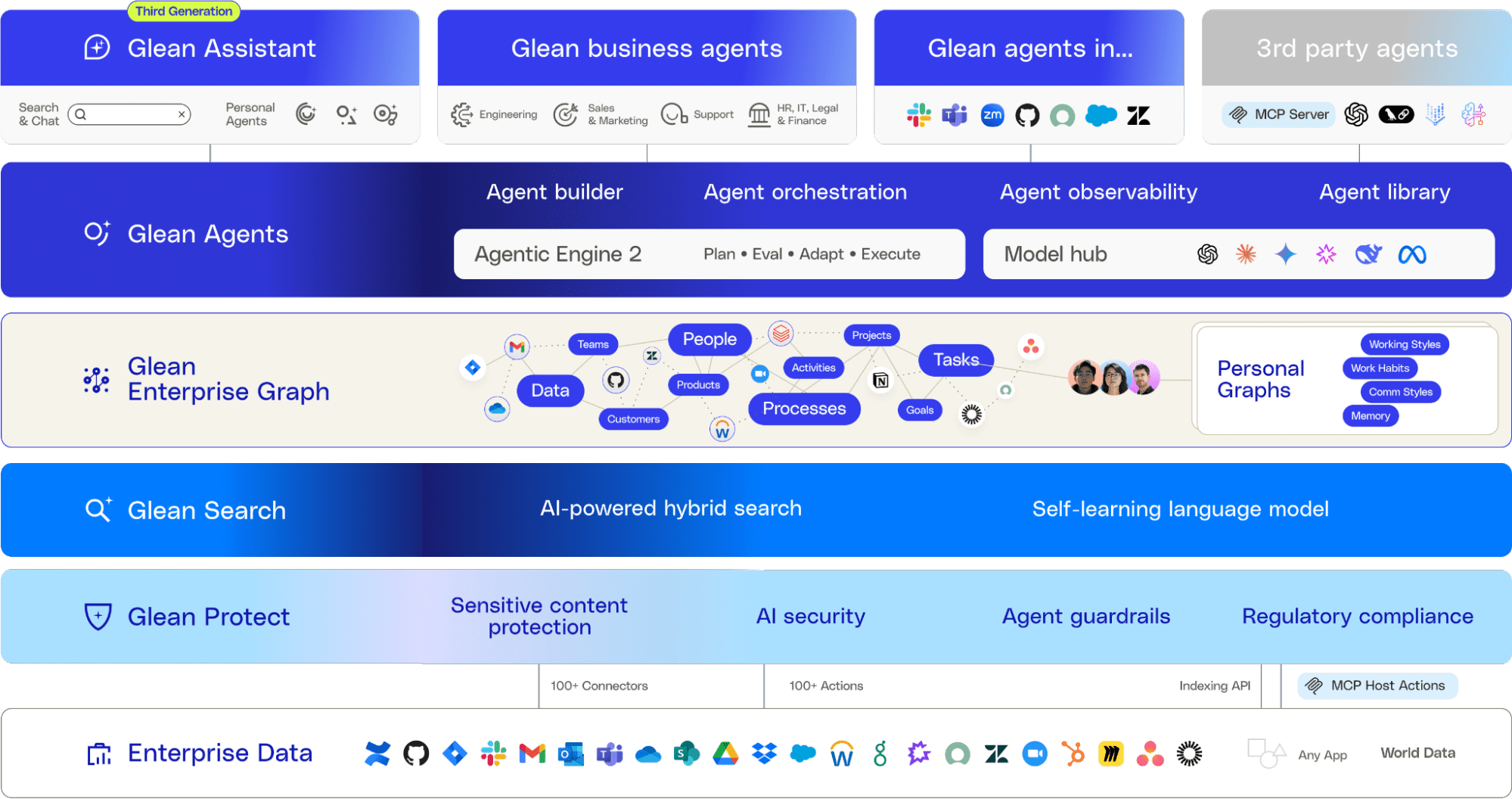
You can ask natural language questions, summarize content, analyze findings from several sources, and receive answers with transparent citations to validate the results. When enabled, Glean can use real-time web search and company information to provide current context while maintaining enterprise controls.
Glean’s major advantages come from its horizontal, platform-agnostic strategy, which stands in contrast to other vertical solutions designed for specific ecosystems. Customers who use these more specific products frequently discover that capabilities outside the ecosystems are underdeveloped, difficult to manage, and less relevant to their enterprise-wide requirements.
Practical Example: SME Agent - Snowflake
In the example below, we’ll be using SME agents created using Glean Artificial Intelligence.
A very practical and functional example is the demonstration of an SME agent created to act as a Snowflake “guru,” enabling consultants from the most inexperienced to the most experienced to consult it quickly and easily, obtaining accurate results.
Let’s consider a scenario in which we have a theoretical question regarding what happens to a table being monitored by a Stream. If this table were recreated, what would happen to the Stream? Would any changes be recorded? Would nothing be recorded? Let’s consult our SME agent:
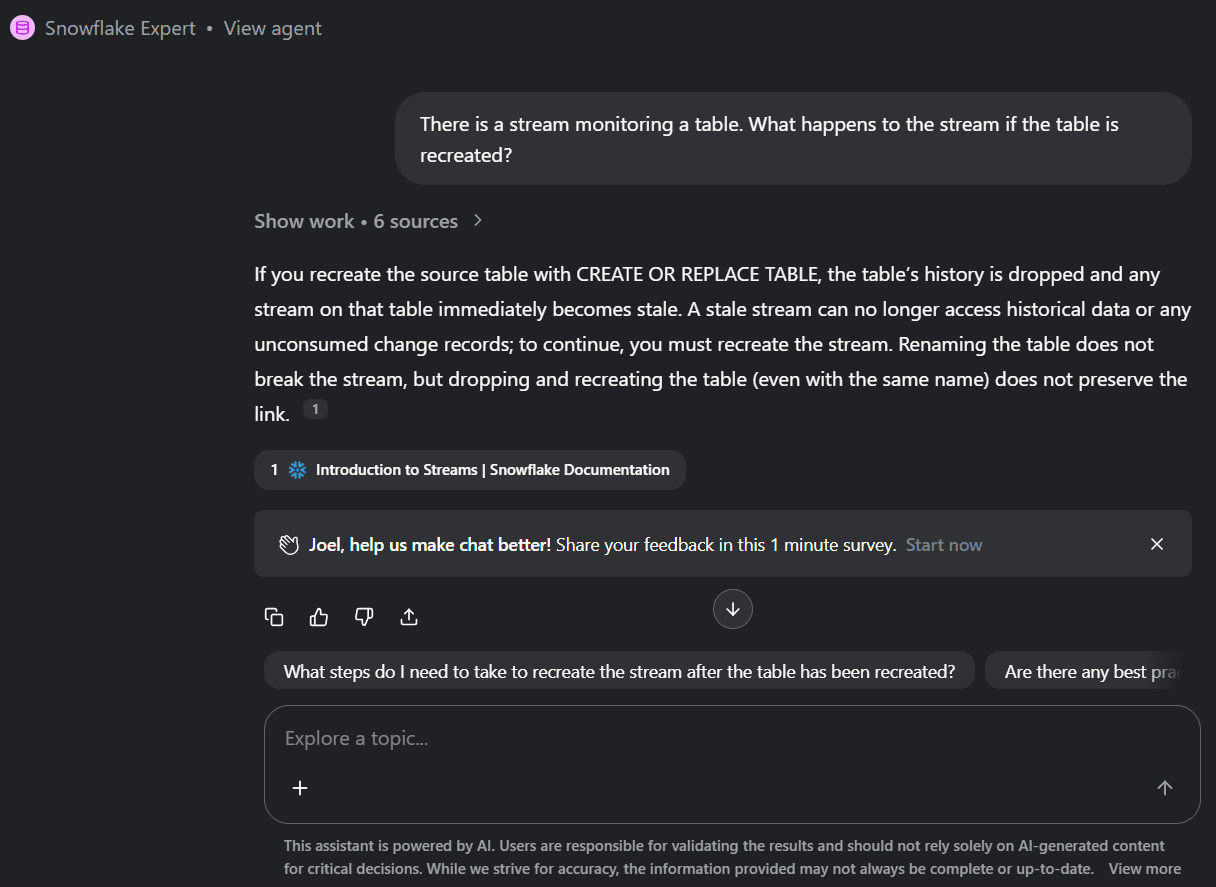
The agent returns an objective, precise, and assertive response. Additionally, it also references and provides a URL containing the official Snowflake documentation on the topic in question.
Beginner’s luck? Let’s try another topic… Let’s say a colleague stated that there is currently a masking policy configured for an external table. How can I verify this information?
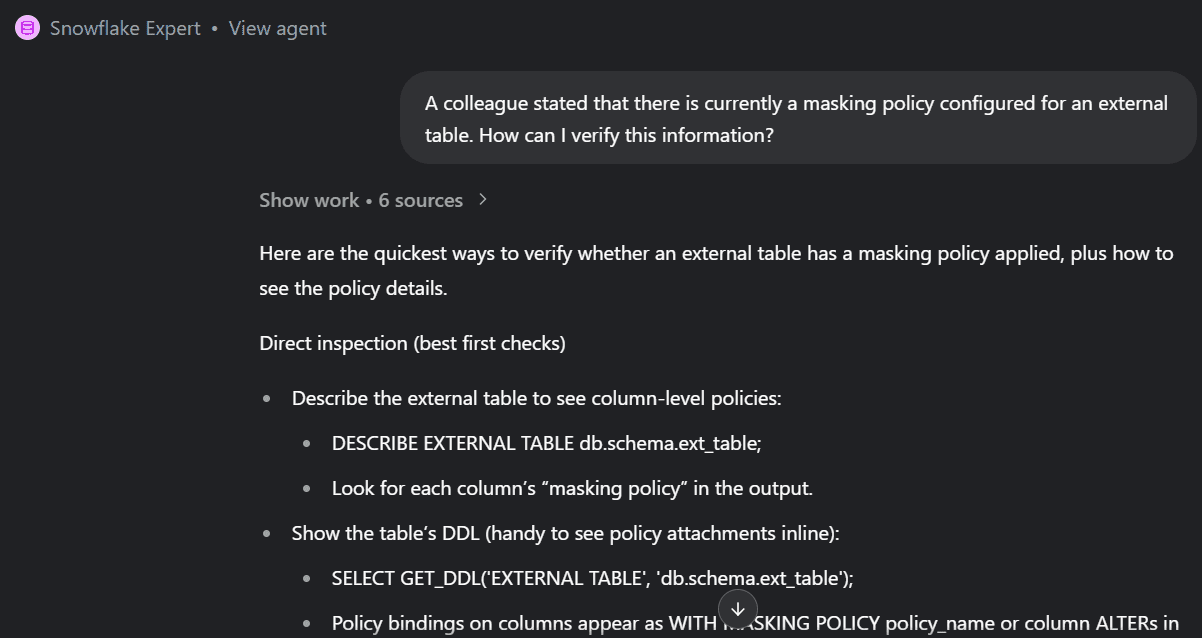
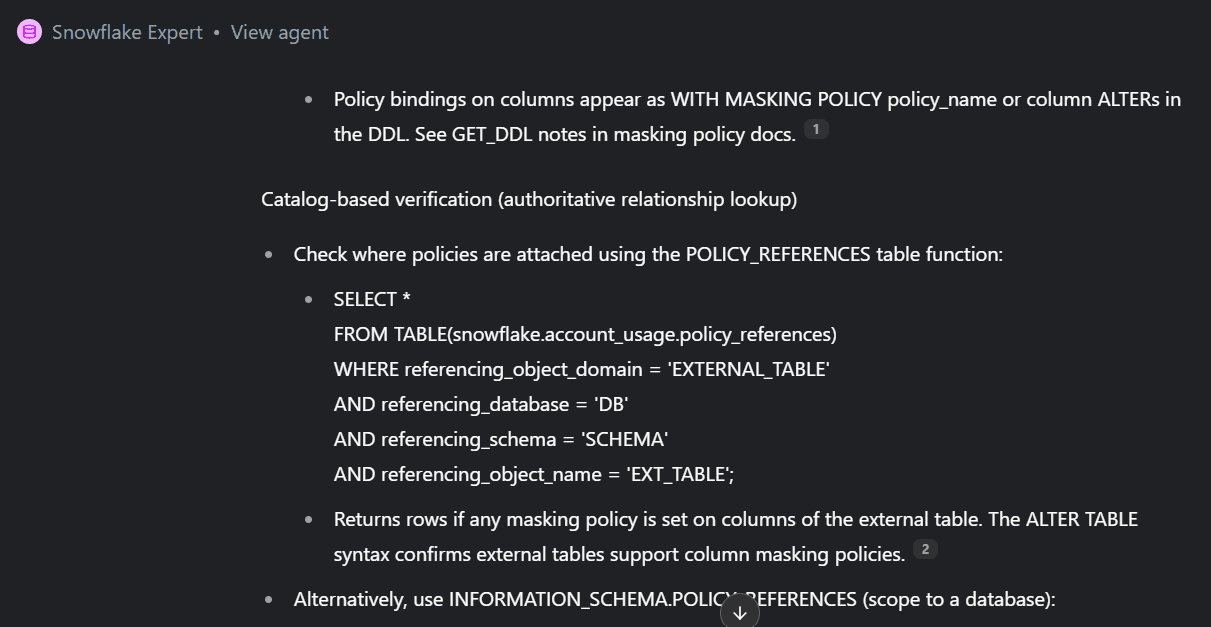
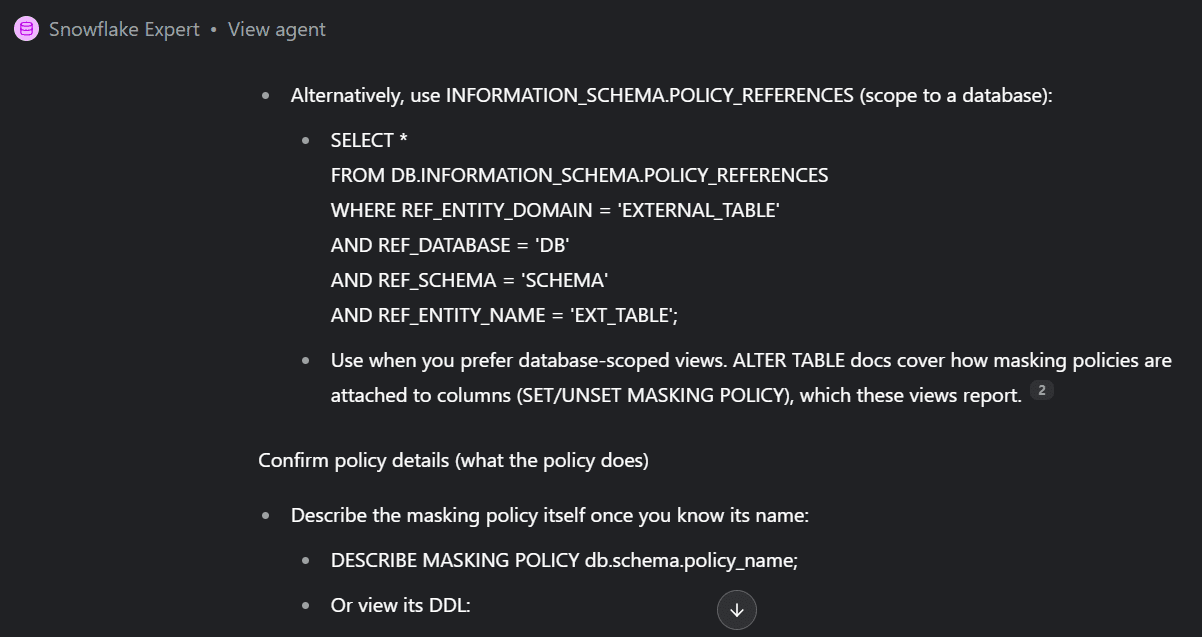
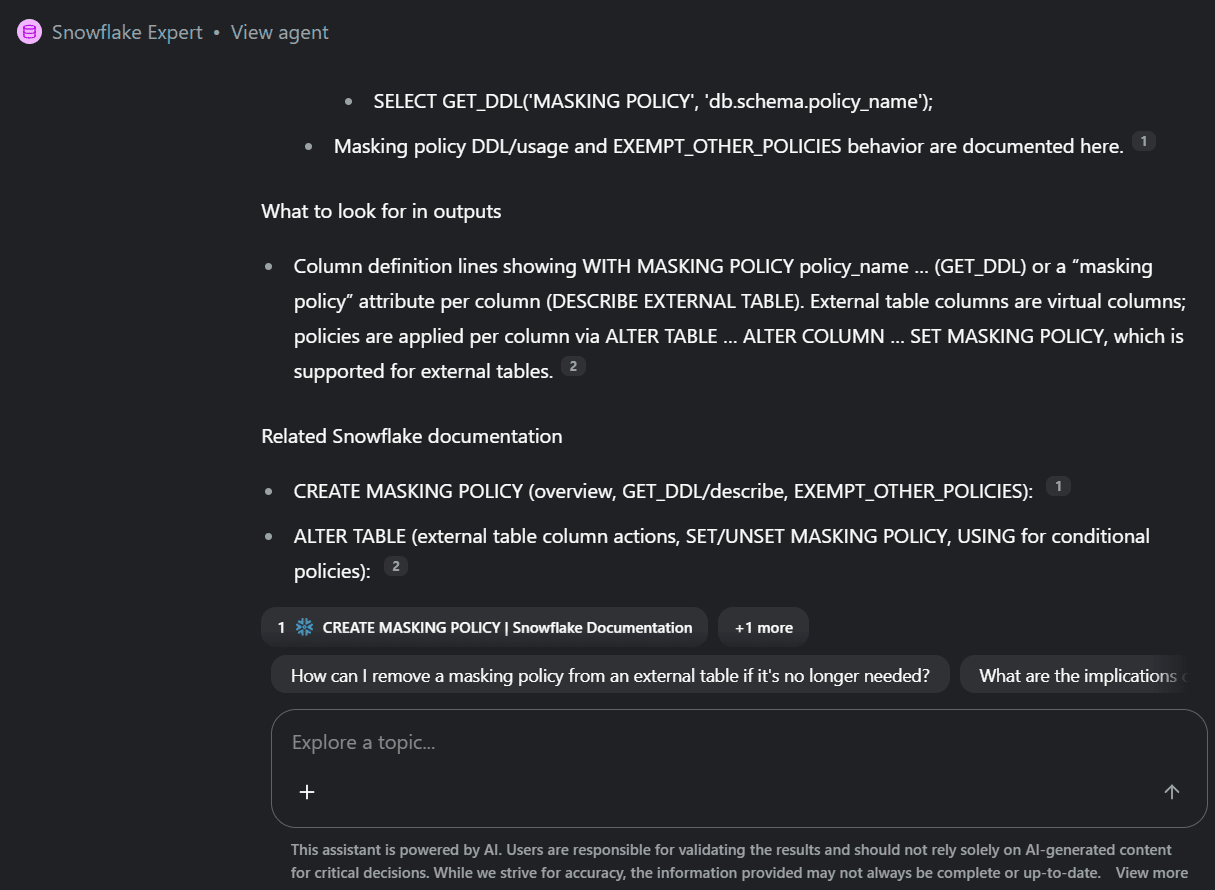
Note that the response is quite long, but once again it was delivered quickly and accurately. It also referenced the official Snowflake documentation.
The agent found several ways to check if policy masking is active, providing a wealth of detail. We made sure to include the full response, albeit lengthy and featuring several screenshots, to demonstrate the agent’s efficiency.
Behind the scenes
When asking questions to the agent, he even demonstrates in a very simplistic way, in real time, some of the steps that happen in the background:

In simplistic terms, the agent is processing the question, analyzing the data sources it has access to, and planning the response.
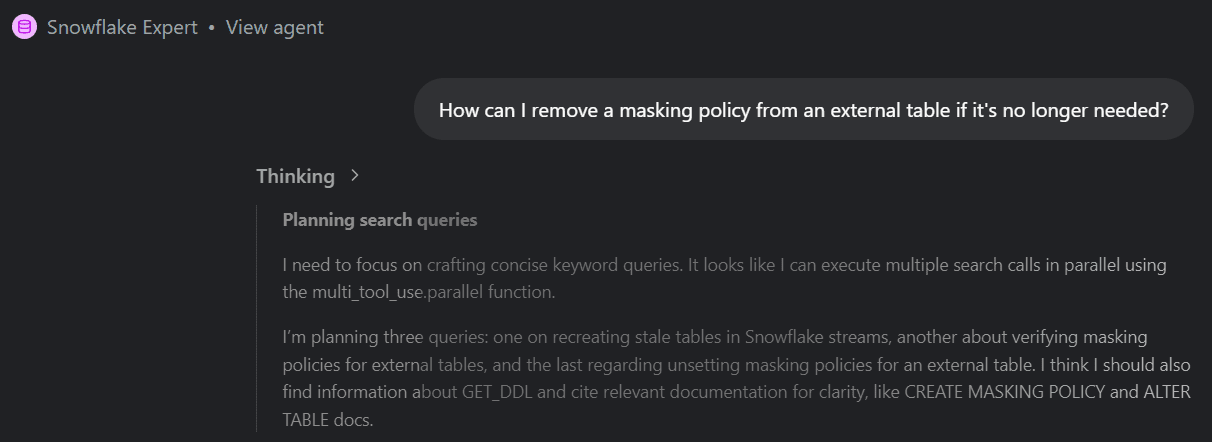
Additionally, we can see that the agent also has the ability to perform parallel processing for more than one call, which also demonstrates the efficient management of computing resource allocation for its activity.
How to Create Agents?
It’s important to note that we won’t go into technical details here, as the goal is to focus on the functionality and practicality that agents can offer us in our daily lives. But let’s briefly understand how this task can be accomplished:
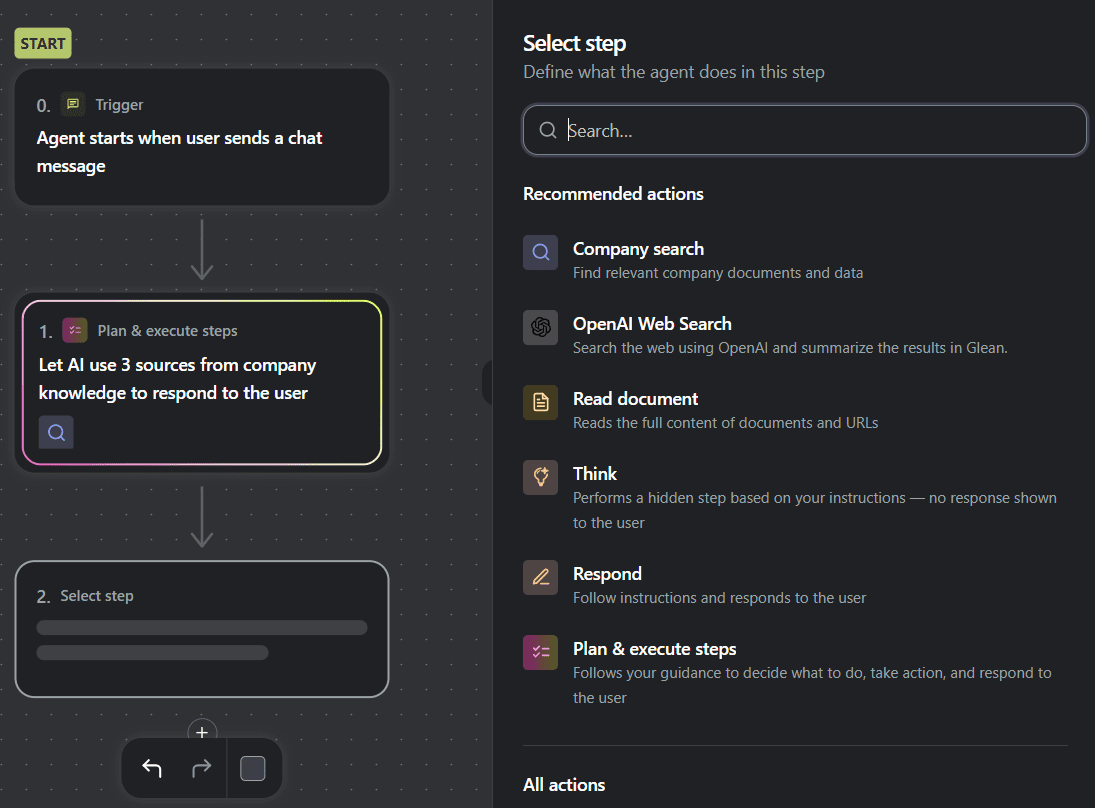
Essentially, we can develop agents by creating a flowchart, where we can add, drag, and drop the desired actions and tasks. This includes a trigger that will launch the agent whenever a user asks a question, how it will plan and execute steps/think, perform searches in data sources, and finally, respond to the user with appropriate and concise content.
Conclusion
SME agents are a creative, efficient, and highly productive option for day-to-day consulting. Development is relatively simple, with the ability to combine internal data sources (company knowledge) and external data sources (such as official manufacturer documentation). Response times are quite fast, performance is good, and they provide objective and assertive answers.
Imagine the universe of possibilities and technologies in which SME agents can be used. In this brief case study, we demonstrated their efficiency for queries related to Snowflake, a complex and nuanced topic that still delivered excellent results. We can definitely help you on this journey!

Ready to explore what SME agents can do for your team?
Contact phData to schedule a quick discovery call or request a tailored proof of concept.


