Data governance is not the hottest topic when dealing with data. It can be challenging, time-consuming, and frankly not as engaging as gaining insights from a new AI model. The tools available for governance can also be daunting and confusing to use. Many organizations do not put the time and effort into data governance that they should, resulting in missing out on a very important piece of the data ecosystem.
However, Coalesce has created a tool called Coalesce Catalog that uses AI to perform as many data governance tasks as possible for you, with minimal human intervention. This allows your organization to take advantage of data governance tools such as data lineage and compliance management, while focusing on your engaging AI models.
In this blog, we’ll explain Coalesce Catalog and how its advanced AI features can help your organization grow.
What is Coalesce?
Coalesce is a data transformation platform designed for engineers and analysts. It is a hybrid development environment that combines code-first and GUI capabilities, allowing users to build complex transformations visually or write code directly. With Coalesce, users can extend and scale their projects using customizable templates for frequently used transformations and automatically generate standardized, best-practice SQL.
What is Coalesce Catalog?
Coalesce Catalog is a modern data catalog and governance platform that helps organizations manage and understand their data. Using AI capabilities, it automatically discovers and catalogs an organization’s data assets by connecting to sources like data warehouses and business intelligence (BI) tools. This creates an up-to-date and comprehensive map of the organization’s data ecosystem, complete with end-to-end data lineage. Coalesce Catalog designed this as a central hub of information that is accessible and easy to navigate for both technical and non-technical users.
What really sets Coalesce Catalog apart is its emphasis on collaboration and usability. It provides a clean, intuitive interface, making it easy for all users to navigate. It also embeds context like lineage, object ownership, and usage stats directly into the catalog so users can quickly access whether an asset is reliable and relevant.
Top Features of Coalesce Catalog
Data Governance
Data Lineage
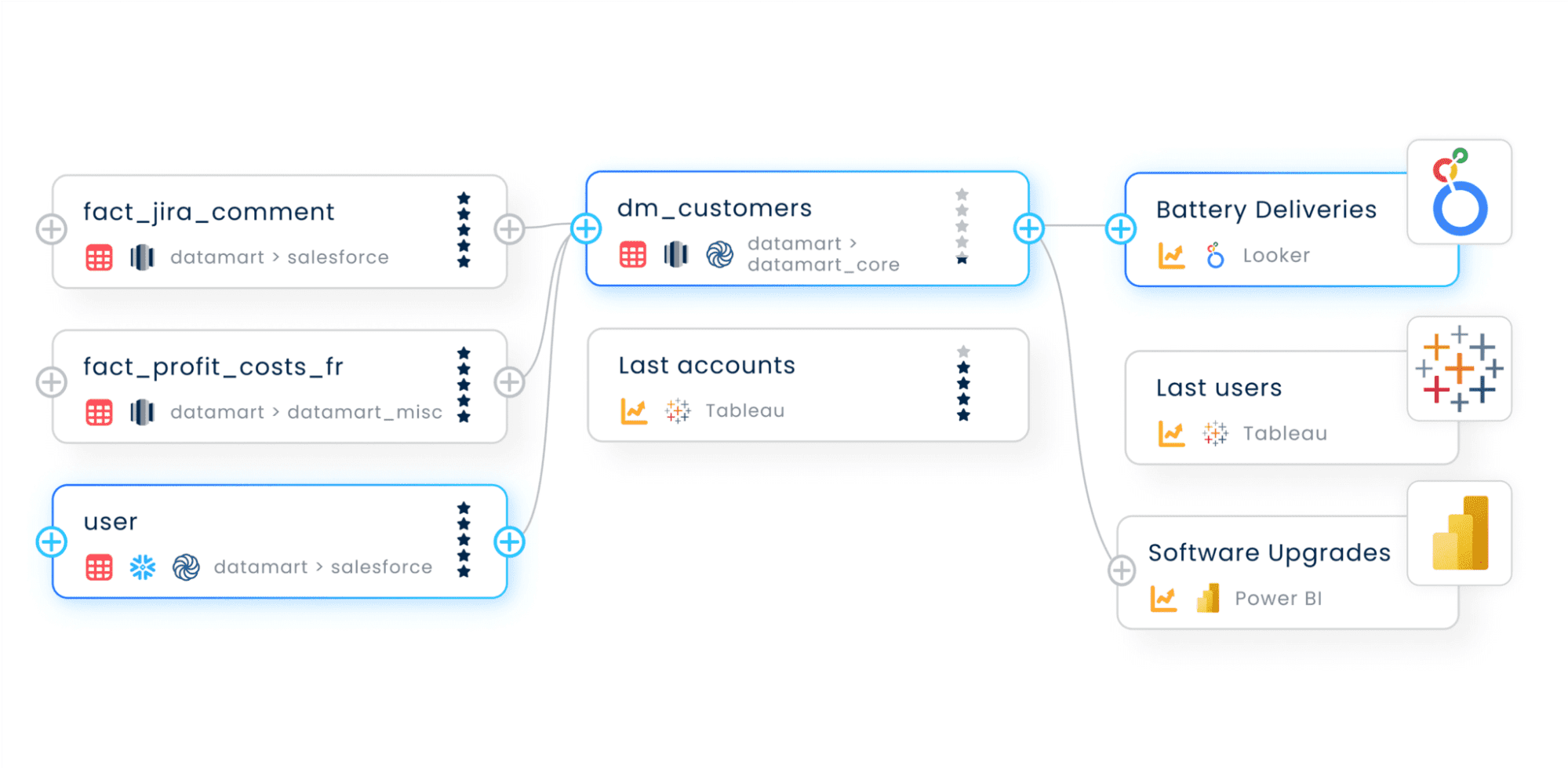
Knowing the lineage of your data is a huge advantage, not only in knowing what’s out there but also in being effective and efficient when building or maintaining your data pipelines. Coalesce Catalog can visualize the lineage of your data from the source to the individual reports in the BI tools it’s being used by. And not just how it presently is, Catalog will take snapshots of how the lineage was in the past, allowing you to view how it evolved. This discovery and documentation of the data is completed automatically by the Catalog’s automated column-level lineage tool.
The lineage is presented as visual and interactive, so users can quickly explore upstream and downstream relationships without digging through the code or reading documentation. By embedding this lineage directly into the catalog, Coalesce Catalog helps data engineers and business users understand the full context of an asset and make more confident, informed decisions.
Security and Compliance
With the amount of user data organizations possess now, it can be daunting to keep it secure and compliant with regulatory requirements. With a simple-to-use interface, Coalesce Catalog offers many features to combat these problems, such as auto-tagging of PII assets, tracking the who, what, and why when users are accessing restricted data, and the ability to control asset owners and access across users and teams. All this allows you to secure your data and be compliant at scale with minimal human effort.
Automated Semantic Layer
Semantic layers are the foundation of BI tools, transforming out-of-context data into business logic that end users can better understand. But this foundation can also be used to give your AI models the context they need to avoid hallucinations and provide answers that better match the reality of your business. Coalesce Catalog can automatically create a semantic layer to bring together scattered business logic from data warehouses and BI tools into a single source of truth to be used by both business intelligence and AI. The semantic layer can be used by Coalesce Copilot and other AI assistants, such as Snowflake Cortex, Databricks Genie, and OpenAI.
Data Assistant
Natural Language Search
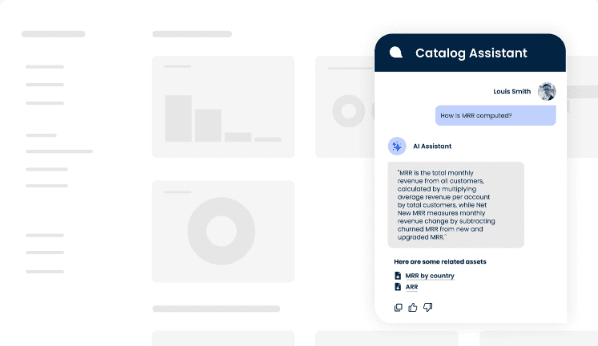
Many companies are finding they have a plethora of data, but the more data there is, the more barriers arise. Business users and analysts sometimes have trouble determining the first place to look for what they need. With Coalesce Catalog’s natural language search, this barrier is eliminated by allowing users to search for data or ask a simple question to get what they’re looking for.
Instead of spending hours researching and creating a query to find a specific data topic, users can ask simple questions such as “What were the total sales in Kentucky last June?” or “What gets filtered out of the MIPS calculation in the Monthly Executive Dashboard?” This way, all users can get quick and correct answers to their data questions without writing a single piece of code.
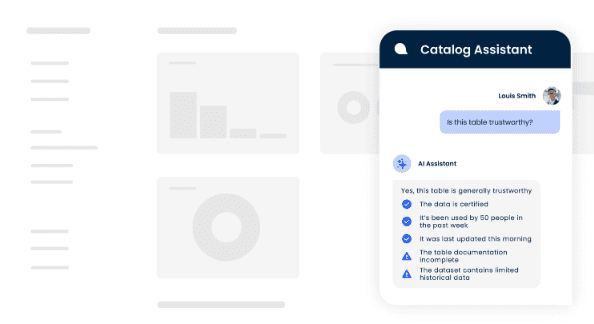
Finding the data is one thing, but knowing it is correct is another. The Catalog Assistant can also help by letting users know how trustworthy a data set is with indicators such as:
Whether or not the data is considered certified
If the data is stale
How many different people have accessed the data
If there’s documentation on the dataset
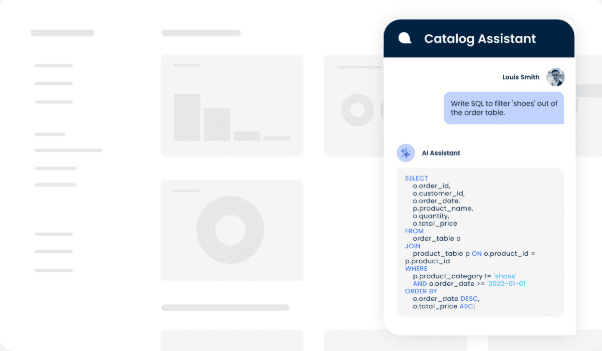
SQL Coding Assistant
Even with the Catalog Assistant answering data questions for you, there are times when you’ll need to use SQL statements. The assistant can also help with that, providing SQL statements based on user prompts that can be directly copied and pasted into your data warehouse.
Closing
As you can see, with all of these automatic AI-powered features, Coalesce Catalog can get your organization on the path to success in data governance. With a robust, easy-to-use data lineage, compliant and trustworthy data, and a natural language assistant to find the data you need in seconds, your data ecosystem can be more efficient and effective. With all those great benefits, having an automated semantic layer for your single source of truth will allow you to create engaging AI models faster and easier than ever before.

Looking for more?
To learn how phData can help you implement Coalesce and unlock these benefits, connect with our team today.
FAQs
How does Coalesce Catalog help with data quality?
The catalog surfaces documentation, ownership, and context for data assets, making it easier to assign accountability and implement quality checks throughout the pipeline.
How often is the data lineage graph refreshed?
The lineage is refreshed when your data is synchronized into the Catalog. This synchronization can be done manually on the source Integrations page or via a scheduled occurrence.