


Customer's Challenge
A leading procurement solutions organization serving enterprise and public-sector members had outgrown its data foundation. Leadership needed to enable profitable category expansion, member growth, and go-to-market efficiency while laying the groundwork for AI-assisted decisioning—without disrupting day-to-day operations. Fragmented master data, inconsistent taxonomies and KPIs, manual reporting, and unclear ownership slowed decisions and created revenue-assurance risk.
phData's Solution
phData delivered a time-boxed Data & AI Strategy that aligned executives on a pragmatic, value-first modernization plan. We defined a governed semantic/metrics layer, a master-data backbone for members and suppliers, a standardized operating model for governance and ownership, and a phased roadmap sequencing quick wins that build toward scalable analytics and AI. The work emphasized reusable patterns (ingestion → curated models → trusted metrics → operational activation) over tool choices, to preserve anonymity and future flexibility.
The Full Story
A national procurement platform had grown rapidly, with new member programs, supplier relationships, and technology investments expanding the data estate across teams. But like many high-growth organizations, data had become siloed and inconsistent.
KPIs and metrics often differed depending on which person was asked, and many business users re-modeled the same logic downstream, creating inefficiency and confusion. Contract data lived across multiple platforms and was difficult to analyze holistically.
Commercial teams stitched reports manually; finance and category leaders spent cycles reconciling rebates and pricing; and legal/compliance lacked centralized visibility into contract obligations, terms, and retention.
phData collaborated with stakeholders across sales, category management, finance, legal, and IT to align strategic goals with a pragmatic modernization plan centered on trusted data, governed access, and repeatable pipelines for analytics and AI.
Assessment
- Conducted stakeholder interviews and current‑state maturity reviews across ingestion, modeling, BI, governance, and AI readiness.
- Mapped critical systems and data flows (ERP, CRM/marketing, contract repositories, supplier portals, marketplace feeds).
- Identified root‑cause issues: master‑data drift, taxonomy sprawl, manual reconciliations, siloed KPIs, and limited lineage/controls.
- Prioritized high business value use cases with clear owners, data dependencies, and measurable outcomes.
Design
- Defined a future‑state Medallion Architecture on Snowflake with Coalesce Transform modeling and a governed semantic layer for consistent, reusable metrics.
- Lightweight data governance roles and processes
- Designed Member & Supplier MDM (deterministic/fuzzy match‑merge, survivorship, hierarchies, golden IDs) and a standardized spend taxonomy.
- Pattern for extracting key fields from unstructured contract documents to populate structured models
- Shaped AI/ML patterns, including Document AI for contracts (terms, pricing, renewal dates, obligations), feature pipelines for churn/lead scoring, and an MLOps framework for governed deployment and monitoring using Azure ML.
Mobilization
- Delivered a 24-month roadmap with tear‑sheets for the first 6–9 months (scope, milestones, resourcing, costs, and value hypotheses).
- A data operating model including stewardship roles, intake processes, and a decisioning forum
- Governance playbooks for ownership, retention, and access policies
- Sequenced quick wins (taxonomy standardization, KPI canon, first data products) to restore trust and prove momentum.

Why phData?
The client selected phData for its proven frameworks, deep experience with data modernization in regulated and operationally complex industries, and a reputation for turning data challenges into business outcomes. Our ability to navigate ambiguity, abstract complexity, and partner with cross-functional teams made phData the ideal transformation partner.
Results
Targeted early outcomes (first 90–120 days) included:
Trusted KPIs & Semantic Layer
Standardized executive metrics (e.g., spend, rebate capture, pipeline velocity, campaign ROAS) exposed through governed BI for consistent “one‑truth” reporting.
Member & Supplier MDM Foundation
Golden IDs and hierarchies improved match rates and cleanly attributed pricing/rebates and revenue across channels.
Faster Reconciliations
A prototype Contract‑to‑Payment data product aligning contract terms, pricing, and actuals accelerated the identification of revenue leakage and exceptions.
AI Readiness
Document-intelligence pilots validated on contract samples, enabling proactive renewal visibility and opportunity surfacing.
Growth acceleration
Unification of CRM + marketing + public‑sector datasets enabled lead scoring and campaign attribution to optimize spend and seller focus.
Business Value
AI‑powered opportunity matching for expiring agreements:
driven by earlier visibility and capture of renewal or rebid opportunities.
Predictive retention and churn reduction:
through early‑warning signals and targeted save actions for at‑risk accounts.
Campaign ROI forecasting and budget optimization:
by predicting campaign effectiveness and reallocating spend toward higher‑return initiatives.
AI-Accelerated Spend Normalization & Savings Proposal Generation:
from compressing cycle times and scaling analyst capacity.
In addition, the roadmap reduces operational risk through embedded controls (DQ tests, lineage, access), improves auditability, and creates reusable AI/ML capabilities that shorten time to value on future models and agents.
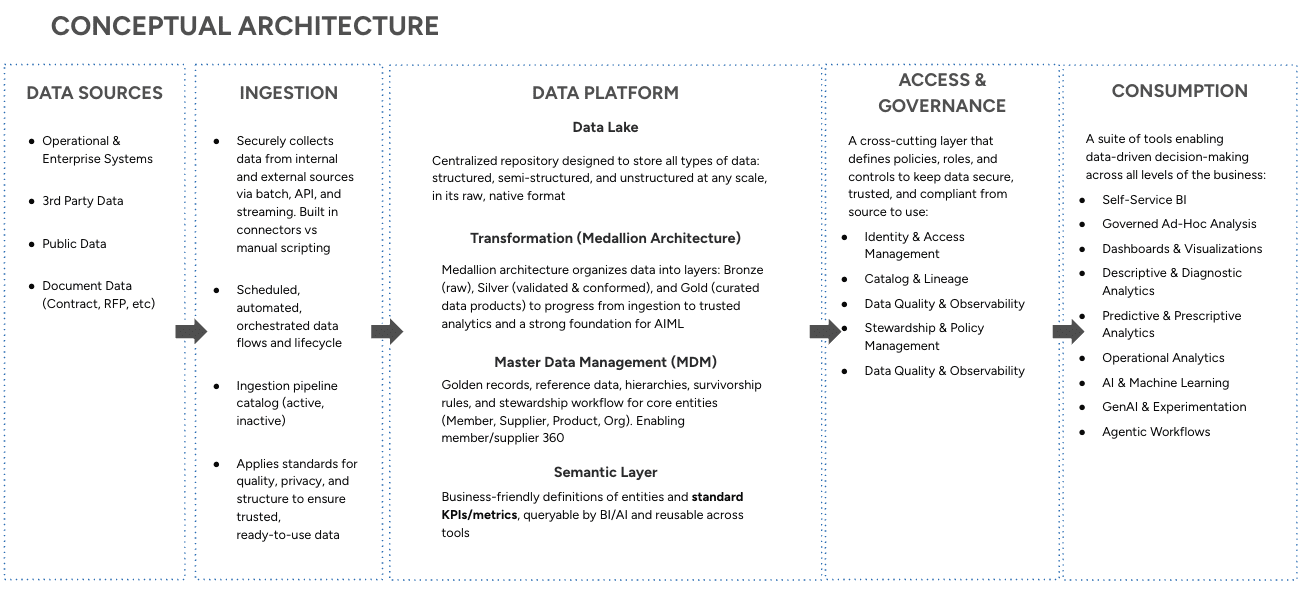
Reference Diagram
The conceptual architecture shows secure ingestion from enterprise, third-party, and document sources into a centralized data platform organized by a medallion approach (raw → validated → curated).
Master-data management and a governed semantic layer sit at the core, while identity/access, catalog/lineage, and data-quality/observability provide cross-cutting governance.
Curated outputs then power self-service BI, dashboards, descriptive/diagnostic analytics, predictive insights, and AI/ML (including GenAI experimentation and agentic workflows).
Take the next step
with phData.
Learn how phData can help solve your most challenging data analytics and machine learning problems.