
An enterprise semantic layer is a structured set of definitions covering metrics, relationships, and source-of-truth designations that gives AI systems accurate business context instead of making probabilistic guesses about what your data means.
You can’t just centralize data. You have to centralize the meaning. Without consistent metric definitions and a knowledge graph connecting your operational, financial, and marketing data, AI produces confident answers anchored to a business that may no longer exist.
Gartner’s 2026 Data & Analytics predictions named universal semantic layers critical infrastructure, placing them alongside data platforms and cybersecurity — the foundational work most organizations are still skipping.
The conversation happens all the time. A company goes through an AI POC. It demos well. Leadership is excited. Then they start building on it in the real-world.
That’s when things fall apart. The AI asks questions of data structures that were never designed to answer them, and it starts confidently producing wrong answers. Not because the model is bad. But because nobody centralized the meaning.
An enterprise semantic layer is a structured set of definitions covering metrics, data relationships, and source-of-truth designations that gives AI systems accurate business context. Without it, you’re asking a model to make probabilistic guesses about what your data means.
Most organizations have centralized their data. The warehouse exists, the pipelines are running, and they’ve been told that having data in one place is what makes AI work. It’s not enough. You have to centralize the meaning.
An enterprise semantic layer is a structured set of definitions covering metrics, data relationships, and source-of-truth designations that gives AI systems accurate business context.
The meeting nobody wants to be in
Finance walks into an executive meeting and says revenue is X. Marketing says revenue is Y. Both numbers came from systems inside the same organization, and both teams think they’re right.
Nobody knows which one to act on, trust in the data collapses, and everyone goes back to their spreadsheets.
That’s been a warehouse problem for decades. With AI, the stakes get higher.
When an AI agent is surfacing answers to customers or driving decisions without a human reviewing every output, inconsistency doesn’t just cause a bad meeting. It creates reputational risk. Business users lose trust in the whole AI program and write it off, even if the model did exactly what it was supposed to do.
Data modeling was something organizations could survive skimping on when analysts were interpreting reports themselves. With AI in the loop, it’s a must-have. There’s no way around it.
What an enterprise semantic layer actually does
A semantic layer has three jobs.
It adds business meaning to your data objects. The definitions that don’t fit neatly into table names and column descriptions.
It defines relationships: how your operational, financial, and marketing data connect.
It encodes metrics. What does “total sales” actually mean for your organization? What’s the consistent calculation across every system that claims to track it? Those calculations need to live somewhere, and the semantic layer is where they go.
A lot of teams think of the semantic layer as just a metric store. That was true of the modern semantic layer when it first emerged back in the Business Objects universe of the 1990’s. But it’s evolved into something more important: a context layer that gives AI systems what they need to answer questions accurately, including questions nobody anticipated when the definitions were written.
Gartner predicted that by 2030 universal semantic layers would be a critical infrastructure, placing them alongside data platforms and cybersecurity. The firm called developing a semantic layer “a must-do for D&A leaders” and named semantic capabilities a nonnegotiable foundation for improving accuracy, managing costs, and stopping costly inconsistencies before they spread.
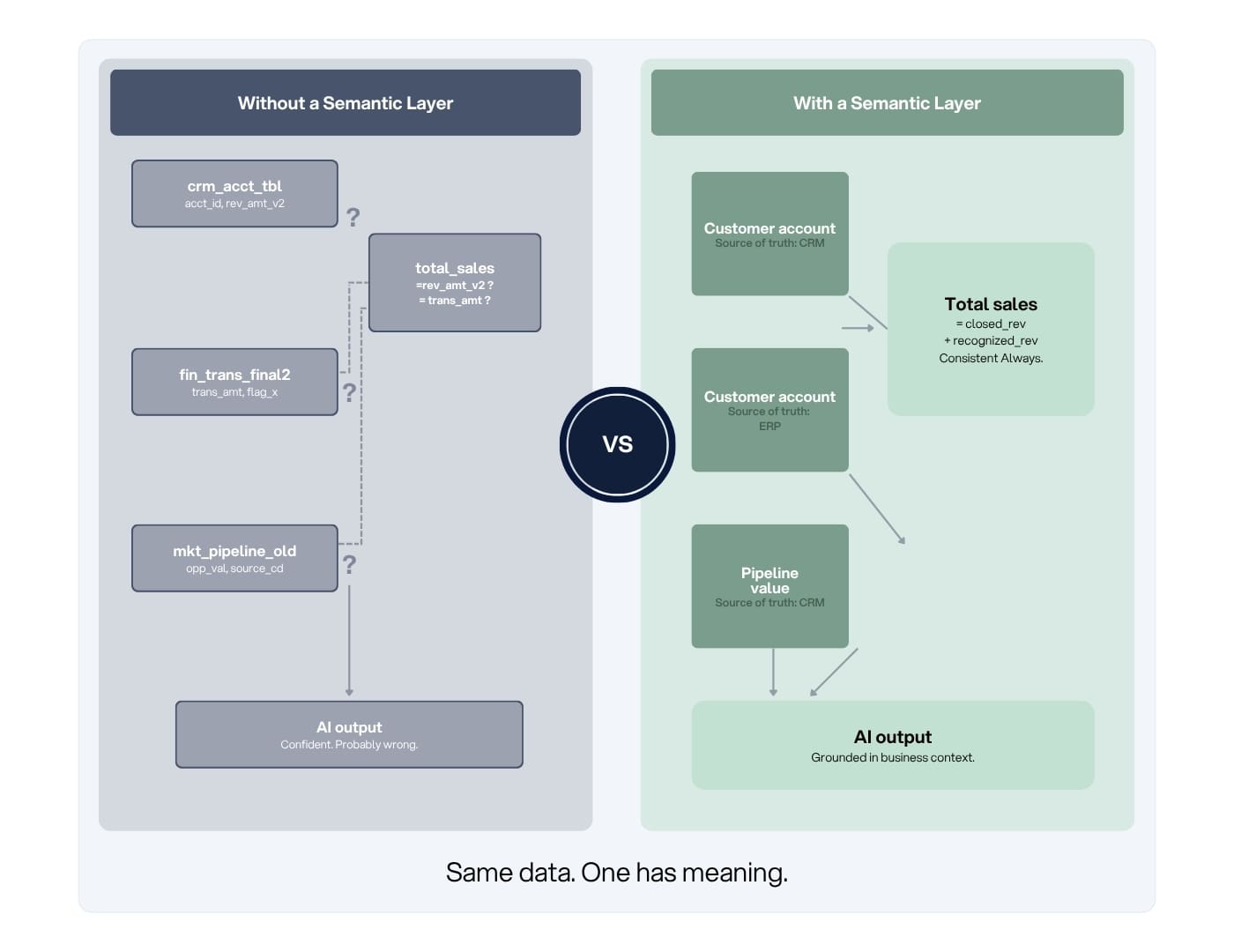
The 20-year-old data model problem
Most organizations also have a compounding issue: data models built for a business that no longer exists.
Products discontinued. Markets shifted. Org structures reorganized twice since the model was built. When you surface that history to an AI system without deliberately deciding what to keep and what to deprecate, you get confident answers anchored to a company that isn’t there anymore.
According to Atlassian’s State of Teams 2026 report, persistent data debt also slows transformation: only 22% of knowledge workers fully trust AI’s accuracy. The most successful teams equip AI with full context, a step that starts by fixing the data foundation first.
The practical work has a few components:
Add definitions to the data objects your business actually depends on for decisions, not everything, just the things that drive decisions.
Encode the metric calculations leadership uses, consistently, across every system that claims to track them.
Build enough of a knowledge graph that your AI understands how different parts of the organization connect.
Finally, make deliberate decisions about what to leave behind.
Where this fits in the Intelligence Platform
The semantic layer sits in the Knowledge layer of phData’s Intelligence Platform — the tier that bridges your data foundation and your intelligence and decision layer.
It doesn’t work without a well-built foundation underneath it. If you have raw data, one-big-table structures, or multiple versions of truth in your data model, the semantic layer can’t fix that. You have to build the foundation correctly first.
But here’s what I tell customers: you don’t build the foundation, then the knowledge layer, then intelligence sequentially. It’s iterative.
When you’re spinning up a new use case, you start from the foundation and build up through the knowledge layer each time. That’s how you get AI that actually scales, instead of just another POC that demos well.
For teams working in Snowflake, Snowflake Semantic Views are a practical on-ramp — SQL objects that encode business entities, metric definitions, and relationships directly in the platform where your data already lives.
Snowflake CoWork’s structured-data path runs through semantic views, and while legacy YAML semantic models still work for backward compatibility, semantic views are the only approach Snowflake supports going forward. As a 7x Snowflake partner of the year, phData helps enterprise teams build semantic foundations that hold up in production.
Where to start
A great way to get started is our data modeling workshop. Think of it as a collaborative design session where we translate your team’s unique business knowledge into clear rules that AI can understand. Instead of spending weeks on theory, we use your real-world data and business goals to build an actionable design you can use immediately.
The organizations operationalizing AI have done this work. The ones stuck after a POC usually haven’t.
phData’s Knowledge layer methodology covers semantics, ontology, metadata, and organizational context as a systematic practice.
Your AI is only as reliable as the meaning behind your data.
See how phData’s Knowledge Layer methodology — semantic layer, ontology, metadata, and organizational context — connects your data foundation to AI that scales.
FAQs
What is an enterprise semantic layer?
An enterprise semantic layer is a structured set of definitions covering metrics, data relationships, source-of-truth designations, and business context that gives AI systems an accurate understanding of how an organization operates. Instead of letting a model guess what “revenue” or “customer” means from raw table names, a semantic layer encodes those meanings explicitly so AI can produce consistent, trustworthy answers regardless of which system the data comes from.
How does a semantic layer prevent AI from producing wrong answers?
A semantic layer prevents wrong answers by establishing which systems are authoritative, encoding consistent metric calculations, and defining how different parts of the data estate connect. When an AI system has that context, it answers based on agreed business definitions rather than making probabilistic guesses about what a table or column is supposed to represent. Gartner forecasts up to 80% accuracy gains for organizations that implement semantic layers by 2027.
Where does the semantic layer fit in the Intelligence Platform?
The semantic layer is a core component of the Knowledge layer, the tier that sits between the Foundation (data infrastructure and modeling) and the Intelligence layer (decisions, agents, and AI applications). The Knowledge layer is where data gets the business context it needs to power reliable, scalable AI outputs. Without it, even a well-built data platform can’t produce AI that answers questions accurately across use cases that weren’t anticipated in advance.
How do you build a semantic layer for enterprise AI?
Start by identifying the KPIs and metrics leadership actually makes decisions on, then encode consistent calculations for those metrics across every system that tracks them. Build out the relationships between your operational, financial, and marketing data. Then make deliberate decisions about which legacy definitions to carry forward and which to deprecate — legacy models built for a business that no longer exists are one of the most common failure modes. phData’s Knowledge layer methodology covers semantics, ontology, metadata, and organizational context as a systematic practice tied directly to production delivery.