Get the blueprint that turns AI spend into ROI
Most enterprises have data, tools, and approved budgets. What’s missing is the enterprise Intelligence Platform that turns AI investments into governed, compounding decisions. This blueprint shows you how to build it.
Preferred Partner
7× Partner of the Year
2025 Design Partner of the Year
Download the blueprint
What’s inside the blueprint
- How to build a unified semantic layer so AI agents interpret business terms like "active customer" accurately.
- How to shift governance from an end-of-project bottleneck into a built-in platform capability.
- How to sequence delivery so the first use case proves economic value and every subsequent one builds on capabilities already in production.
- A complete diagnostic matrix assessing your current state across core dimensions: Data Foundation, Knowledge Layer, AI Capabilities, Governance, and Organization.
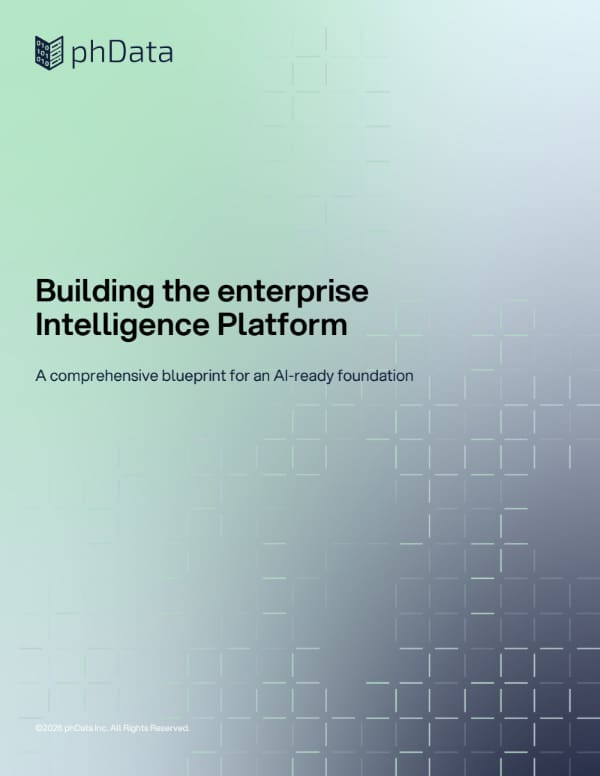
Download the blueprint to get instant access to the architecture diagrams, maturity matrix, and deployment frameworks.
What you need for an enterprise Intelligence Platform
phData defines an Intelligence Platform across three layers — Foundation, Knowledge, and Intelligence — each built on the one below it. Most enterprises have pieces of one or two. The blueprint explains what all three require, how they connect, and why the sequence matters for AI to work at scale.
What I want every IT leader to understand is that this is not a throwaway of everything you have already built. For organizations that have modernized their data system, this is an augmentation and an acceleration, plus new capabilities in the Knowledge and Intelligence layers.
— Adam Fokken, CTO, phData
Frequently asked questions
What is an enterprise Intelligence Platform?
An enterprise Intelligence Platform is a connected set of capabilities that helps an organization turn data into trusted decisions and actions on an ongoing basis. It has three layers: Foundation (data infrastructure), Knowledge (business definitions and semantic context), and Intelligence (decisions and agent-driven actions), with each layer built on the one below it.
How is an Intelligence Platform different from a data platform we already have?
A data platform stores and processes data. An Intelligence Platform uses the data platform as a starting point, then adds the Knowledge layer (shared metrics, business definitions, mapped relationships) and Intelligence layer (governed AI capabilities and agentic workflows) that turn data into decisions.
What does governance look like inside an Intelligence Platform?
Governance in an Intelligence Platform covers four core capabilities: access control (role-based permissions on data, models, and agent capabilities), data lineage (tracking where data originates and how it was transformed), cost governance (managing token usage and compute spend across AI workloads), and agentic oversight (defining the boundaries within which autonomous agents can act without human review).
What is phData Forge™ and how does it help deliver an Intelligence Platform?
phData Forge™ is an AI-native, sprint-based delivery methodology that runs across all four steps of the Intelligence Platform engagement. For each platform capability, Forge™ encodes phData’s best practices as agent skills. An AI agent, guided by an integrated engineering team, speeds delivery while maintaining the architectural discipline production requires. Every sprint produces a working decision asset.
How are you building your intelligence?
Download the blueprint, or talk to us about scoping your first use case.