

How a meal delivery leader built an AI platform that personalizes the subscriber experience
In seven weeks, phData built an enterprise AI agent platform on Amazon Web Services (AWS). The agent is able to hold conversations, remember user preferences, and keep allergen and dietary rules enforced in production.
At a glance
| Industry | Food tech, subscription commerce |
| Scale | Chef-crafted meal delivery leader serving over a million meals a week throughout North America |
| Challenge | Unify fragmented ML assets into a governed, production-ready enterprise AI agent platform with safety enforcement for allergens and dietary restrictions |
| Technology | Amazon Bedrock AgentCore (Runtime, Gateway, Identity), AWS Lambda, Amazon VPC, AWS IAM, Amazon S3, Amazon ECS, Terraform, Statsig, Strands Agent SDK, Anthropic |
| Timeline | Seven-week embedded delivery |
| Result | Production-ready conversational AI bot and reusable enterprise AI agent platform on AWS |
| Phdata Service | AI & Machine Learning, AWS |
Meal recommendations are personal, and the stakes are higher than they look
Signing up for a meal delivery service usually starts with a quiz. But a quiz captures a snapshot, not a person. A subscriber who just started a new workout routine, or just learned they have a gluten sensitivity, needs a system that understands plain language and responds with meals that fit. A static quiz can’t do that. A search bar gets close, but puts the work back on the subscriber. When dietary restrictions involve allergens, getting it wrong is a safety failure.
The client’s existing pieces lived in separate codebases with no shared foundation. The company needed a partner who could help build an agentic platform powered by AWS that powers multiple agentic flows. A single connected system that holds a conversation, understands subscriber goals, and recommends meals with allergen and dietary rules enforced at every step.
Without a shared foundation, every team building AI features would solve the same problems from scratch. The client needed one platform everyone could build on.

With phData and AWS, we were able to build an agentic platform. And then on top of that agentic platform, we were able to build an AI conscious LLM bot that the customers can use in a conversational way to find the meals that are right for them.
— Director of Engineering, Chef-crafted meal delivery leader
How phData built an enterprise AI agent platform
phData embedded a Forward Deployed Engineer (FDE) with the client’s engineering team for seven weeks. Four decisions shaped what got built.
phData built on Amazon Bedrock AgentCore rather than engineering custom infrastructure
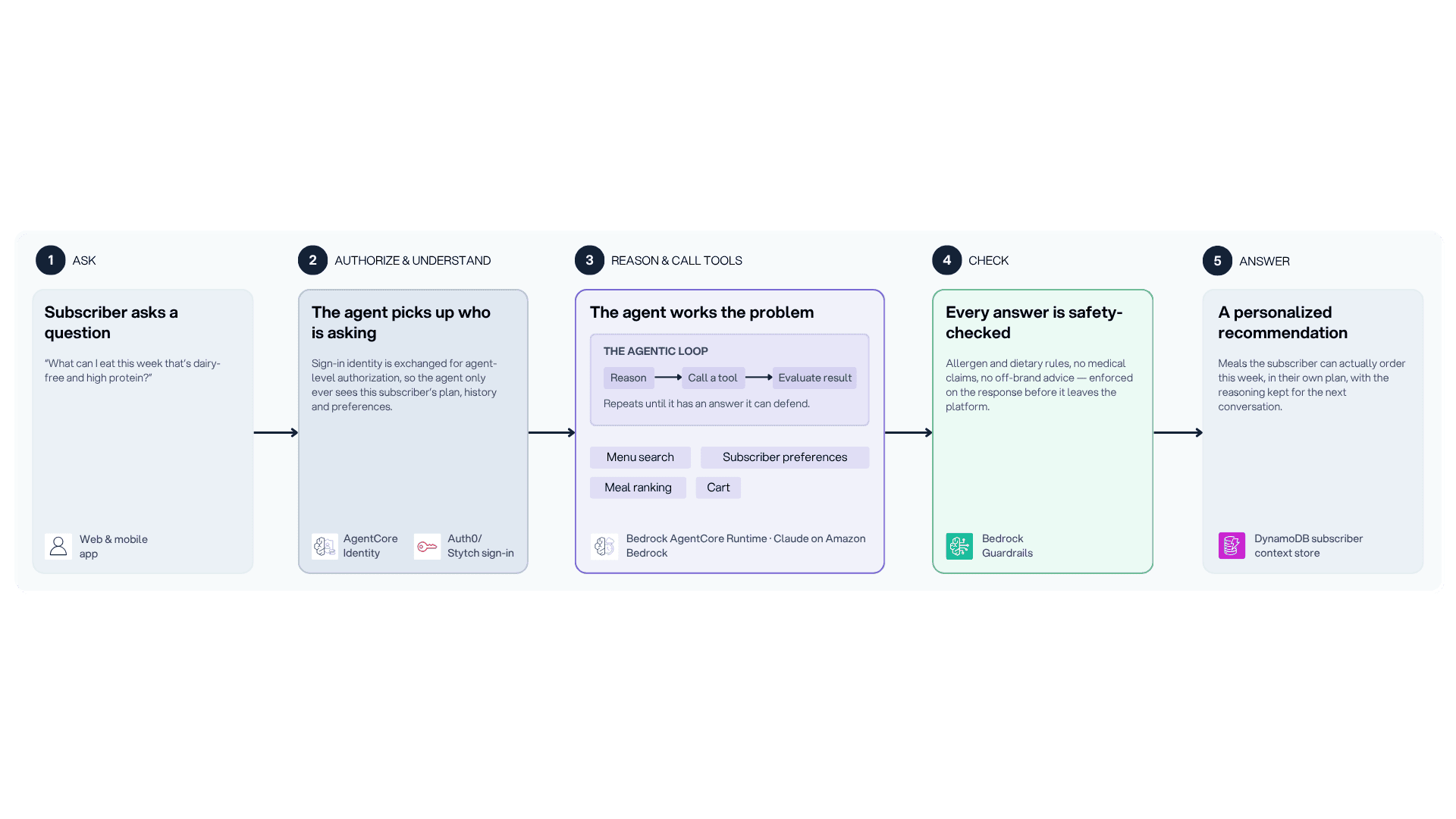
Amazon Bedrock AgentCore is the AWS service the platform runs on. It powers the agent in production, connects it to data securely, and controls which users can access what. Three components do the work:
AgentCore Runtime orchestrates the conversational agent: managing reasoning steps, deciding which tools to call, and maintaining context across multi-turn subscriber conversations.
AgentCore Gateway registers and secures each external tool the agent can call, including the client’s existing ML meal ranking endpoint and LLM-based ranker, so the agent can invoke them without direct API exposure.
AgentCore Identity handles user-level authorization, ensuring the agent only surfaces data and recommendations scoped to the authenticated subscriber.
phData connected the client's existing AI work into one system
The client had a conversational bot in progress and a meal ranking model. phData registered both as tools in AgentCore Gateway and unified them inside a single agent running on AgentCore Runtime. Took seven weeks to production with no starting over.
phData engineered safety into every layer of the system
Amazon Bedrock Guardrails provide a strong foundation, working alongside the client’s internal application-level safety checks in a layered approach. Together, they keep responses aligned with dietary, allergen, privacy, and safety requirements. The client uses Claude as the primary reasoning LLM within the agent.
phData helped build the system to fit how the client already runs
The full infrastructure stack included AWS Lambda for serverless tool execution, Amazon ECS for containerized agent workloads, Amazon S3 for data storage, Amazon VPC for network isolation, and AWS IAM for access control. It was provisioned using Terraform templates aligned to the client’s existing YAML-based service catalog. No bespoke setup for their engineers to reverse-engineer after the engagement ended. AgentCore Observability and Bedrock Trace logging gave the client full visibility into agent interactions, tool calls, latency, and operational traces.
Why phData
The chef-crafted meal delivery leader had a tight deadline and a complex codebase. They needed a partner with the architectural depth to make high-stakes decisions quickly, the hands-on experience to execute in a complex production environment, and the credibility to know when to build and when to use what AWS already provides.
phData is an AWS Premier Tier Services Partner with a track record of delivering production-grade agentic AI systems on AWS. phData embedded a FDE within the client’s team for the full seven-week engagement. The client retained ownership of day-to-day implementation, while phData defined the architecture, resolved the complex infrastructure decisions, and ensured the system was built to scale. Every architectural decision, integration pattern, and configuration choice was captured in a reusable playbook.
For the chef-crafted meal delivery leader, that translated into a seven-week delivery that would have taken most teams six to nine months to architect and build from scratch — and a platform capable of scaling to hundreds of thousands of subscribers, with multiple internal teams already positioned to build on the same foundation.
There are a lot of other scenarios that we plan to build on top of the agentic platform, and a huge part of us being able to deliver that goes to AWS and phData.
— Director of Engineering, Chef-crafted meal delivery leader
Why AWS and Amazon Bedrock AgentCore
AWS was selected because it represents the most complete foundation for the client to build, deploy, and operate AI in a production enterprise environment.
User data, order history, menu content: it all lives there. Building the AI system on the same foundation meant secure connections to everything, with no separate cloud to spin up.
Amazon Bedrock AgentCore addresses what has historically been the hardest part of enterprise AI: moving from a working prototype to a reliable, secure, production system. It provides managed orchestration, authenticated tool connectivity, session memory, and identity-aware access controls, the operational scaffolding that agentic systems require to function safely at scale. Amazon Bedrock AgentCore made a 7-week timeline achievable. It runs the agent, connects it to external tools and data through a secure gateway, and controls access by user identity. For the client, this eliminated months of custom infrastructure work and allowed the engagement to focus on business logic rather than platform engineering.
Data proximity was also a decisive factor. AI systems that operate close to their data sources are faster, more secure, and architecturally simpler to govern. Because the client’s core data — order history, user profiles, menu content already resides in AWS, the AI system accessed it through native, encrypted connections with no cross-cloud exposure and no replication overhead. That architectural alignment reduced both risk and complexity from the outset.
Amazon Bedrock Guardrails enforced dietary and allergen constraints at the model output layer, in production, without custom filtering code – an example of the platform absorbing complexity that would otherwise fall to the application team. Compute, storage, observability, and deployment were configured as infrastructure-as-code and integrated with the client’s existing engineering standards.
AWS offers not just the tools to build AI, but the integrated infrastructure to operate it reliably at scale with the security controls, governance frameworks, and enterprise maturity that production deployments demand.
Amazon Bedrock AgentCore was the best possible solution.
— Director of Engineering, Chef-crafted meal delivery leader
What the chef-crafted meal delivery leader has now
The client now has a production-ready conversational AI system delivered in in seven weeks and built on the shared foundation every future AI initiative at the company will run on. The system holds conversations with subscribers, remembers their preferences, enforces dietary and allergen rules, and delivers personalized meal recommendations tailored to each customer’s goals.
The initial rollout targeted 100,000 subscribers, with the architecture designed to scale to the client’s full customer base. At that scale, the business impact is substantial.
The chef-crafted meal delivery leader now sees:
-
3× improvement in recommendation acceptance, from an estimated 12% baseline with non-personalized surfacing to a projected 35-45% acceptance rate, directly increasing order value per subscriber per week
-
8–12% improvement in subscriber retention among AI-engaged users, representing a meaningful reduction in churn across a subscription business where each retained subscriber compounds in lifetime value
-
60%+ reduction in meal-selection support contacts, as the conversational AI resolves preference and recommendation queries that previously required human intervention
-
99%+ safety compliance across all allergen and dietary constraint enforcement, applied at the model output layer in production, with zero reliance on custom filtering logic
-
A shared AI platform already positioned to support customer support, voice, and additional channels with multiple internal teams building on the same foundation within the first year
-
AgentCore’s local development setup sped up our testing and prevented us from long change-deploy-test cycles. On average, about 10 minutes per code change was saved.
to production-ready enterprise AI agent platform on AWS
initial rollout
Ready to see what a similar engagement could look like for your organization?
Why this matters beyond this project
Every subscription business collects preferences at signup. Few actually use them. The subscriber who said they’re vegetarian gets a beef feature. The one cutting carbs gets pasta recommendations. That gap is a churn risk. In categories involving allergens or medical dietary needs, it’s also a safety risk.
A connected AI system on AWS that runs on existing data, enforces safety rules, and compounds into new use cases without rebuilding the foundation each time is something every subscription service could use. It applies anywhere accuracy and safety both matter: fitness, healthcare, financial wellness, and more.
For companies that want to move fast without building the wrong thing, phData’s embedded model delivers the right system decisions early, so the end product runs in production.

Customer Stories

How a K-12 edtech company built a personalized learning platform for millions of students
Discover how one of the largest K-12 edtech companies built a production-grade personalized learning platform with Claude on AWS Bedrock and Snowflake, saving $1M+ annually.


Frequently asked questions
What is an enterprise AI agent platform and how is it different from a chatbot?
An enterprise AI agent platform is a governed infrastructure layer that enables AI agents to plan and execute multi-step tasks using tools, memory, and safety enforcement, rather than responding to a single prompt. A chatbot typically handles one-turn or scripted interactions with no persistent context; an enterprise AI agent platform supports multi-turn reasoning, tool calls, identity-aware access, and configurable guardrails across multiple teams and use cases. phData partnered closely with the client’s engineers to productionize and integrate the conversational AI experience into a reusable platform foundation.
How long does it take to build a production-ready enterprise AI agent platform on AWS?
phData delivered the client’s enterprise AI agent platform in a seven-week engagement using an embedded model combining one phData Senior ML Solutions Architect with three CookUnity engineers. Timeline depends on the complexity of existing ML assets, safety requirements, and integration scope. Companies with existing ML ranking or recommendation systems can often compress delivery timelines by unifying those assets into the agent rather than rebuilding.
What AWS services does phData use to build an enterprise AI agent platform?
phData’s enterprise AI agent platform for the client used Amazon Bedrock AgentCore (Runtime, Gateway, and Identity), AWS Lambda, Amazon VPC, AWS IAM, Amazon S3, and Amazon ECS, with all infrastructure provisioned through Terraform. Observability and evaluation relied on AgentCore Observability, Bedrock Trace logging, and Bedrock Model Evaluations.
Ready to build an enterprise AI agent platform on AWS?
phData’s AI and ML team builds production-ready agentic AI systems on AWS, from architecture through launch.
- Free scoping conversation — no commitment
- AWS-certified data and AI engineers
- Proven delivery