Monolithic AI agents fail silently in production because when the model owns an entire workflow end-to-end, there’s no clean boundary where debugging can begin or governance can be applied.
Snowflake Cortex Agents are best deployed as narrow, specialized reasoning modules with scoped data access and typed input/output contracts, each handling one bounded task rather than an entire pipeline.
The most consequential architecture decision is keeping macro-orchestration out of the LLM entirely: Snowflake Tasks and stored procedures own pipeline control, so failures surface as loud, containable validation errors instead of silent data loss.
Every agent invocation, tool call, and intermediate output should be logged to Snowflake governance tables, holding AI workflows to the same auditability standard you’d apply to high-stakes ETL.
Many teams considering AI in production already know the value proposition. What they often don’t know is that the architecture decisions made in week one quietly determine whether the system is auditable, debuggable, and safe to run against real customer data six months later. The most common early mistake: a single, general-purpose agent that owns the entire workflow end-to-end.
This post lays out a functional approach to agentic architecture using Snowflake Cortex Agents, with the best practices and guidelines our data teams apply in production.
Why Snowflake is the right platform for governed multi-agent AI
Snowflake answers two questions every developer and executive is asking right now: how should we build this, and how do we govern what we build?
With AI, governance isn’t optional. The tools are new, the failure modes are unfamiliar, and AI increasingly behaves like another developer on the team. The technology rarely shows its work. The core governance requirements haven’t changed, but how we apply them has, because that opacity feeds the perception of AI as a black box: something goes in, something comes out, and the middle is invisible. We can’t fully control how an LLM reasons internally, but we can tightly govern what it’s allowed to do, what data it can touch, and how its outputs are used.
The case against monolithic agents
A single, general-purpose agent that handles every step of a workflow is the architectural equivalent of a black box; when it fails, you have no idea why. If the model produces a flawed executive sales summary, the root cause could live in retrieval, in reasoning, in formatting, or in any of a dozen implicit handoffs it made internally.
The failure mode isn’t just operational; it’s grounded in well-documented LLM limitations. Liu et al. (2024) showed that language models exhibit a “lost in the middle” effect: when relevant information sits in the middle of a long input context, retrieval accuracy degrades sharply. A monolithic agent loaded with a sprawling system prompt, multiple tool definitions, retrieved documents, conversation history, and few-shot examples is exactly the condition the paper describes. The same overload encourages recency bias; the model anchors on whatever instructions came last and discounts earlier constraints. In a governance context, that means quietly ignoring the rule that mattered most.
Why narrow, specialized agents outperform
Narrow, specialized agents are the antidote, and the advantages compound.
Bounded reasoning reduces hallucination. When an agent has one clearly scoped task, a small toolset, and a typed input/output contract, there’s less surface area for the model to invent plausible-but-wrong behavior.
Bespoke model selection unlocks cost optimization. A small, cheap model is perfectly adequate for structured data extraction or routing. Reserve larger, more expensive reasoning models for steps that genuinely need them. Within Snowflake, that maps directly to choosing among the models available through Cortex AI per node, rather than paying flagship-model rates for every call in the pipeline.
A clean path to fine-tuning and local models. Once a node is narrow and well-instrumented, its inputs and outputs become a high-quality dataset, positioning the team to fine-tune or host a smaller, custom model for that specific node later.
This is the multi-agent approach Snowflake itself advocates, and the platform’s native capabilities for access control, logging, and orchestration make it a practical home for it. Snowflake Cortex Agents, Snowflake Tasks, and Snowpark Container Services (SPCS) compose a governed runtime with less overhead than most alternatives.
Let LLMs reason. Let Snowflake macro-orchestrate.
There are two kinds of orchestration in any agentic system, and they don’t get the same treatment.
Micro-orchestration happens inside a single agent’s turn, picking which tool to call, deciding what argument to pass, choosing whether to retry. This is probabilistic by nature and is exactly what Snowflake Cortex Agents are designed to do well. Letting the agent handle this is fine.
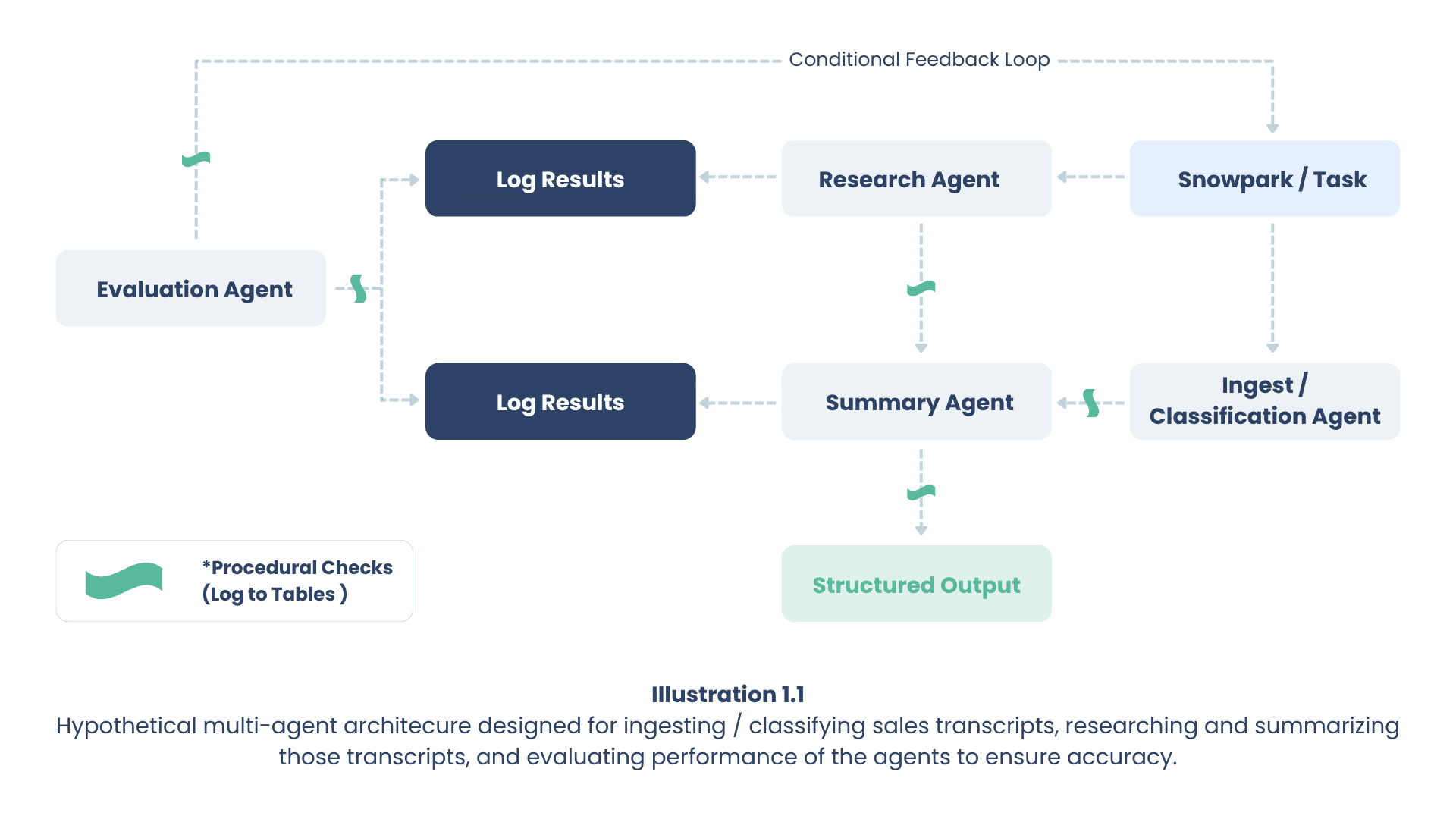
Macro-orchestration drives the pipeline itself, deciding which agent runs when, keeps track of where state is persisted, knows how handoffs are validated, and executes fallback on failure. These operations must be deterministic. They belong to Snowflake Tasks and stored procedures, not to an LLM.
The distinction matters because when LLMs are allowed to drive macro-orchestration, errors propagate silently.
A concrete example
Imagine an agent responsible for generating an upstream dataset and passing it to a downstream SQL-generating agent. Somewhere in the chain, the LLM hallucinates a column name: customer_status instead of customer_state. There’s no SQL error if the hallucinated name exists on a related table, or if the join silently drops the unmatched rows. Half a table’s records quietly disappear from a downstream report, and nothing in the logs flags it.
When structured processes own the handoff between scoped agents, that same failure becomes a loud, contained validation error caught at the boundary. Schema-validated payloads, deterministic routing, and rule-based gates between steps become observable and editable steps in the workflow.
In practice, this means:
Workflow state lives on disk, not in LLM context.
Agent outputs are validated against a schema before the next step runs.
An LLM never executes a system step without a rule-based check in front of it.
Snowflake Tasks handle scheduling and dependency chaining; stored procedures handle advancement logic, validation, and error handling.
Treat agents as reasoning modules, not system governors.
Design agents with strict data and tool boundaries
Specificity is the design goal. Each agent should have clearly defined inputs, scoped data access, and a structured output schema. This makes expected behavior precise enough that deviations actually mean something, which is what allows a governance team to set meaningful alerts in the first place.
Consider an agent designed to analyze customer feedback and complaints. With the scope fixed, it’s straightforward to assert that this agent gets read-only access to the feedback dataset and produces output in a defined schema: JSON with typed fields for sentiment, category, and confidence. That is the function of a well-scoped agent in totality. It doesn’t need write access nor does it get to invent new output fields.
This design discipline reduces hallucination risk, improves auditability, and simplifies debugging. The best agent in a governed system is not the most capable in the abstract. Rather, it’s the one that operates under the principle of least privilege. In our delivery work, the principle of least privilege at the agent level has become as non-negotiable as it is at the data layer.
Multi-agent systems only hold up at scale when each agent is narrow in scope, limited in data access, and predictable in inputs and outputs. Every agent should be assigned:
A specific role (for example, ‘classify claim emails,’ ‘summarize negotiation history,’ or ‘generate executive dashboard narrative’).
A narrow toolset: SQL over specific schemas, a single ticketing API, or search over one particular vector index. Where retrieval over unstructured data is needed, Cortex Search provides a hybrid index that can be scoped per agent rather than exposed account-wide.
A structured input/output schema: typed JSON fields, enumerated categories, and confidence scores.
Data access is governed through standard Snowflake primitives: role-based access control, row access policies, and schema isolation. For workloads that need a custom runtime, those agents can be hosted directly in SPCS, inheriting the same RBAC perimeter rather than running off-platform.
Persist state and log everything
If there’s one rule worth internalizing about agentic workflows: any human-observable step must be recorded. Prompts, models used, confidence scores, execution timestamps, intermediate outputs between agents, and the SQL or API calls each tool invocation produced. A well-designed system can be traced end-to-end.
The standard worth holding to is the same one we’d hold a senior developer to: the work should be documented well enough that someone else can audit it, reproduce it, or pick it up cold. A practical pattern is to model agentic workflows the way you’d model high-stakes ETL.
Core logging tables
Workflow runs: one row per business request, with timestamps, status, owner, and final outcome.
Agent steps: one row per agent invocation capturing agent name, input summary, output summary, reasoning tokens, model version, and confidence scores.
Tool invocations: each SQL query or external API call triggered by an agent, joined back to agent steps.
Prompt and output storage: for high-risk workflows, store full prompts and responses (or redacted versions where PII is involved) to support after-the-fact audits.
The teams that win won't be the ones that shipped first
At phData, our team brings together practitioners from across the data and AI world. What we’re seeing is the early innings. The teams that come out ahead won’t be the ones that shipped an AI feature first. They’ll be the ones whose AI features were quietly, boringly, demonstrably governed from day one.
If you’re working through how to apply this to your own platform, or trying to decide whether to refactor a monolithic agent into something you can actually defend in an audit, we’re here to help.

Ready to move from AI experimentation to production?
Learn how our 4-week 3-2-1 GO engagement can help you ship a governed AI MVP.
FAQs
What are Snowflake Cortex Agents?
Snowflake Cortex Agents are a fully managed agentic platform built into Snowflake’s governed environment. They handle reasoning, planning, tool selection, and execution, combining structured data access via Cortex Analyst with unstructured retrieval via Cortex Search. Each agent operates within Snowflake’s existing access control and governance framework, making them production-ready without requiring a separate orchestration stack.
How do multi-agent systems on Snowflake differ from a single monolithic agent?
A monolithic agent owns an entire workflow end-to-end, making failures hard to trace and governance nearly impossible to enforce. Multi-agent systems on Snowflake assign each agent a narrow, bounded task with a defined input/output schema and scoped data access. The macro-orchestration is handled by Snowflake Tasks and stored procedures, not by the LLM, so failures surface as loud, containable errors rather than silent data loss.
How does Snowflake govern multi-agent AI workflows?
Snowflake applies the same RBAC and row access policies to AI agents that it applies to human users, so no new security machinery is required. Agents hosted in Snowpark Container Services (SPCS) inherit the same governance perimeter. Snowflake Tasks own macro-orchestration, ensuring that handoffs between agents are deterministic and logged. Every agent invocation, tool call, and prompt can be recorded to governance tables for audit and reproduction.
What is the difference between micro-orchestration and macro-orchestration in agentic AI?
Micro-orchestration refers to the decisions an agent makes within a single turn: which tool to call, what arguments to pass, whether to retry. This is probabilistic and handled by the LLM. Macro-orchestration refers to pipeline-level control: which agent runs when, how state is persisted, how handoffs are validated, and what happens on failure. Macro-orchestration must be deterministic and should be owned by platform tools like Snowflake Tasks and stored procedures, not by an LLM.


