
Enterprises deploying AI broadly without a shared Intelligence Platform end up with dozens of disconnected agents that can’t agree on basic definitions, let alone build on each other’s work.
An Intelligence Platform has three layers — data, knowledge, and intelligence — and the knowledge layer (shared semantic definitions, ontologies, business context) is the one most organizations skip and the most common reason agents produce contradictory answers.
AI model capability is doubling roughly every seven months, which means the compounding disadvantage of a siloed agent architecture resets on the same clock — waiting is a strategy that gets more expensive fast.
The path to a compounding platform isn’t a two-year top-down build; it’s letting the platform emerge use case by use case, reusing components until the shared substrate is assembled from real business needs.
What happens when you deploy AI agents without a platform
I have a confession. Someone at my company (sorry, Brian) spent $800 in Anthropic tokens to generate a weekly meal plan. Chicken marsala on Tuesday, if you’re wondering. I wanted to fire off a Slack message calling them out. I really did. But I’m the one who turned everything on. I handed everyone access to Claude, told them to experiment with enterprise AI agents, said don’t worry about it, and then acted surprised when I had to justify why a meal plan was sitting next to our production churn models on the same invoice.
Brian is the outcome of a strategy I chose. And that distinction matters a lot right now, because most enterprises are making the exact same choice I did: distributing AI access broadly, celebrating the experimentation, and not recognizing what happens when there’s no Intelligence Platform underneath any of it.
An Intelligence Platform is the shared infrastructure layer that combines governed data with a semantic knowledge model and a single set of common definitions, so agents can behave consistently and build on each other’s value over time. When you build agents across the enterprise without that foundation, they don’t share anything, they contradict each other, and every new use case starts the cost meter from zero again.
When I opened the AI token floodgates, that’s exactly what I saw. My team built agents. Marketing built agents. Customer service built agents. Developers built agents wherever they could. For a while, it looked like the dream scenario: an organization racing up the AI learning curve, fast.
Then I looked closer. We had 240 agents across the business. Built by dozens of different people. Sharing exactly nothing. No common data model. No shared definition of what a “customer” actually means. No common semantic layer. Each one solved maybe 80% of its problem, and not a single one could compound on what the others had built.
The meal plan wasn’t the embarrassing part. The embarrassing part was that our churn prediction agent and our revenue forecasting agent couldn’t even agree on what ARR meant.
Distributed AI innovation tends to produce the same outcome whenever it lacks a shared foundation. Without a common substrate — an Intelligence Platform with shared data, unified semantics, and governed infrastructure — you don’t get cumulative progress.
With a platform in place, your AI capabilities compound across the organization; without it, you end up with a disconnected collection of features.
Why enterprise AI agents don’t compound without a shared platform
There’s a research lab at Berkeley called METR that studies the ability of AI models to complete complex tasks. They’ve found that models are doubling in task-completion capability roughly every seven months. Moore’s Law took 18 months to double transistors. AI capability is moving more than twice as fast.
What this means for enterprise AI agents is uncomfortable: someone who looks reckless in March could look clairvoyant by October. The cost of waiting to see what your competitor does is a compounding disadvantage, and it resets every seven months. That’s what pushed me to just turn everything on and see what happened.
The compounding advantage only accrues if your platform is built to compound. If 24 agents all define “customer,” “revenue,” and “churn” differently, you get 24 parallel experiments that can’t learn from each other. The magic is in the common layer beneath the agents: governed data, a shared semantic model, and a knowledge layer that gives every agent the same ground truth to work from.
Three things break when you try to roll back AI agents
Once you’ve gotten into this spot with a bunch of different agents without a common language, and a lot of enterprises already are, rolling back is genuinely hard. Three things break at once.
First, the beloved feature problem. The developer who built that agent built it with their taste, their prompt design, their particular way of handling edge cases. Deprecating it is a political decision, not a technical one. Expect at least two angry emails.
Second, the CFO question. At some point (and I’d bet on the second half of this year for a lot of organizations) the question stops being “what are we doing with AI” and becomes “what return are we actually getting”. Without measurement infrastructure in place from day one, you’ll find yourself explaining that developers are probably 20% faster, and then answering whether that means you fire one in five.
Third, and most importantly: nothing compounds. Every use case built on a siloed foundation is a dead end. The value doesn’t stack. The second agent can’t inherit anything from the first. You pay full price, every time, for every capability.
How to build an Intelligence Platform that compounds
An Intelligence Platform turns company data, knowledge, and processes into decisions and actions by both humans and agents. It has three layers: the data layer (governed, ingested, reliable), the knowledge layer (semantic definitions, ontologies, shared business context), and the intelligence layer (use cases, agents, decisions).
Most organizations rush to build the intelligence layer first and skip the knowledge layer entirely. But the knowledge layer is what ensures consistency. It’s what lets a churn prediction agent and a revenue forecast agent actually agree on what a “customer” is.
As a Snowflake Elite Services Partner and seven-time Partner of the Year, phData sees the same pattern again and again. Companies neglect the knowledge layer.
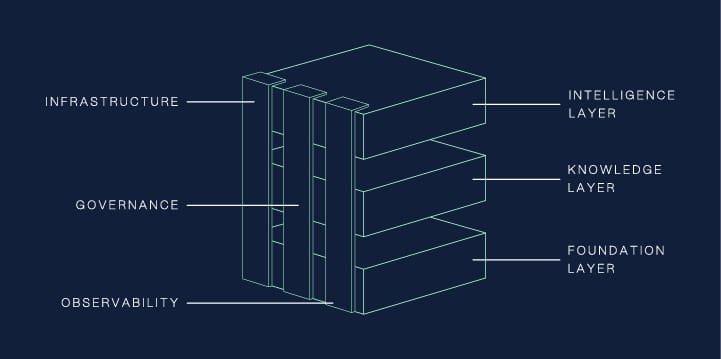
We recommend skipping the top‑down, “build it all first” platform approach. That’s a two‑year, eight‑figure mistake. Instead, let the platform emerge from real use cases.
Start with your highest‑value use case. Get specific: what data does it need, what are the semantic definitions, and what governance is required? Build just those components. Then move to the second use case. Reuse three of the four components you already created, and add only what’s missing.
By the time you’ve delivered the fifth use case, most of the platform is in place. Assembled incrementally from real business needs rather than a theoretical architecture. From there, every new use case becomes cheaper, faster, and more accurate.
For this to work, you need the right operating model. Leadership sets clear business priorities, like revenue, profitability, or a mix of both. AI champions sit inside the business and identify the highest‑value use cases. A platform team builds and maintains the shared substrate. Innovation then happens in a distributed way, but within this structure.
The $800 was tuition
I don’t regret Brian’s meal plan. Not entirely. It taught me something a slide deck couldn’t. When you give people access to a powerful tool with no platform beneath it, they’ll build what’s obvious to them. The problem lay in the architecture.
The opportunity in front of every enterprise right now is real. AI models are getting better every seven months. The use cases are there. The organizations that win will be the ones who build an Intelligence Platform that lets every experiment make the next one cheaper, faster, and more accurate. Which is how you compound. And eventually win.
Stop treating AI initiatives as disconnected projects.
Get the blueprint to build a foundation that compounds value across your enterprise.
FAQs
Why does distributed AI agent deployment fail at enterprise scale?
Enterprise AI agents fail when teams build agents independently without shared data models, semantic definitions, or governance. Each team resolves the same foundational questions separately: what is a customer, what does ARR mean, which users count. The result is siloed agents that can’t compound on each other, redundant spend, inconsistent outputs, and an AI portfolio where nothing builds on anything else.
What is a knowledge layer in an Intelligence Platform?
A knowledge layer is the semantic layer of an Intelligence Platform that provides AI agents with shared business definitions, ontologies, and context. It ensures every agent operating on enterprise data works from the same definition of key concepts: customer, revenue, churn, user, rather than interpreting raw data independently. The knowledge layer is the most commonly skipped component in enterprise AI agent deployments and the most common cause of agents producing inconsistent or contradictory answers.
What does compounding value mean in the context of enterprise AI agents?
Compounding value in enterprise AI means that each new agent or use case built on a shared Intelligence Platform costs less, deploys faster, and performs better than the one before it, because it inherits governed data, shared semantic definitions, and reusable infrastructure from prior use cases. Organizations that build agents on a common platform stack advantage over time; those that build siloed point solutions start from scratch with every new capability, paying full cost each time.


