
The gap between AI experiments and agentic AI enterprise systems comes down to shared context: knowledge, tools, rules, and workflows in the system, not scattered across individual laptops.
Individual copilots improve personal productivity. Shared agents create enterprise leverage by giving everyone the same context, approved tools, and consistent rules.
Transform tasks before redesigning roles. Build systems, measure what changes, and let the org model follow the evidence.
All happy families are alike; each unhappy family is unhappy in its own way.
— Leo Tolstoy, Anna Karenina
I keep coming back to that quote when I think about agentic AI in the enterprise.
Over the past two years I’ve sat through so many enterprise AI reviews I’ve lost count. I see the same pattern again and again. All it takes is ten minutes, and I can tell whether a company is making progress or spinning.
The ones making progress look a lot like a happy family, like the insurance company where we built an underwriting agent that re-imagined what the workflow should look like entirely. Or the procurement organization where we replaced shopping tasks with agentic ordering.
The ones struggling are fragmented, and each dysfunctional in their own unique way. Maybe they turned on Copilot or Gemini and waited for productivity to appear. Others adopted the AI features embedded in their existing software. Still others rushed toward the most capable reasoning model available without solving the harder problem: how work, context, and systems actually come together.
AI value comes from turning undisciplined prompting into repeatable systems.
Three ways to become an unhappy AI family
1. Turn it on and wait
Over the last couple of years, many organizations rolled out tools like Copilot or Gemini with the expectation that broad access would naturally lead to broad productivity.
It did not.
Some power users found real efficiency and are producing more output than ever while many barely changed how they worked.
Meanwhile, AI-generated output greatly increased the amount of information we must read, process, and comprehend. It’s getting harder and harder to distinguish our colleagues’ true thoughts from the surrounding AI output. Many organizations are starting to drown in AI slop. That is why the return on investment is often so difficult to see.
A company can deploy AI broadly without knowing whether it improved team-level or enterprise-level performance. Usage is easy to measure. Business impact is not.
Individual usage does not automatically become an enterprise capability.
2. Rely on embedded AI
Embedded AI are AI capabilities built into software you already use, rather than a separate tool you go to. And it tends to make AI easier to adopt because the workflow already exists.
The vendor has defined the use case, placed the feature inside a familiar product, and narrowed the number of decisions the employee needs to make. AI assistance inside CRM, HR, service, and workflow platforms will often move faster than a net-new AI application.
That is useful. It is also becoming table stakes.
If every company uses the same software and receives the same AI features from the same vendor, those features can help a business keep up without helping it differentiate.
Embedded AI improves the existing workflow. It does not necessarily create a new one.
3. Deploy the most powerful models for end users
The third pattern is the rush toward the newest and most capable reasoning models. They are popular for a reason. Teams are clamoring for them because they can handle harder cognitive tasks, produce better results, and often feel meaningfully more capable than the models that came before them.
The problem is that the cost model is changing at the same time.
AI vendors are increasingly moving toward token-based pricing. The more a model reasons, reads, writes, and revises, the more tokens it consumes, and the more the organization pays. A team can move from a modest software subscription to a meaningful operating expense without realizing how quickly the usage is accumulating.
Most end users do not have enough understanding of how these models work to select the right model for each task or optimize their usage. They choose the most capable option because it is available, familiar, and usually produces the best result in the moment. That is rational from the individual user’s perspective. It is not always rational at enterprise scale.
Agentic AI in the enterprise creates a better way to manage this. A team can choose the right model for the task, route work to less expensive models when they are sufficient, monitor behavior, and see where usage is creating cost without creating value. The system can be tuned and observed in a way that individual users and one-off prompts cannot.
A more powerful model, used more efficiently, is still not a connected business system though.
The systems that work share context
The successful pattern is simpler than it sounds:
The systems that work share context.
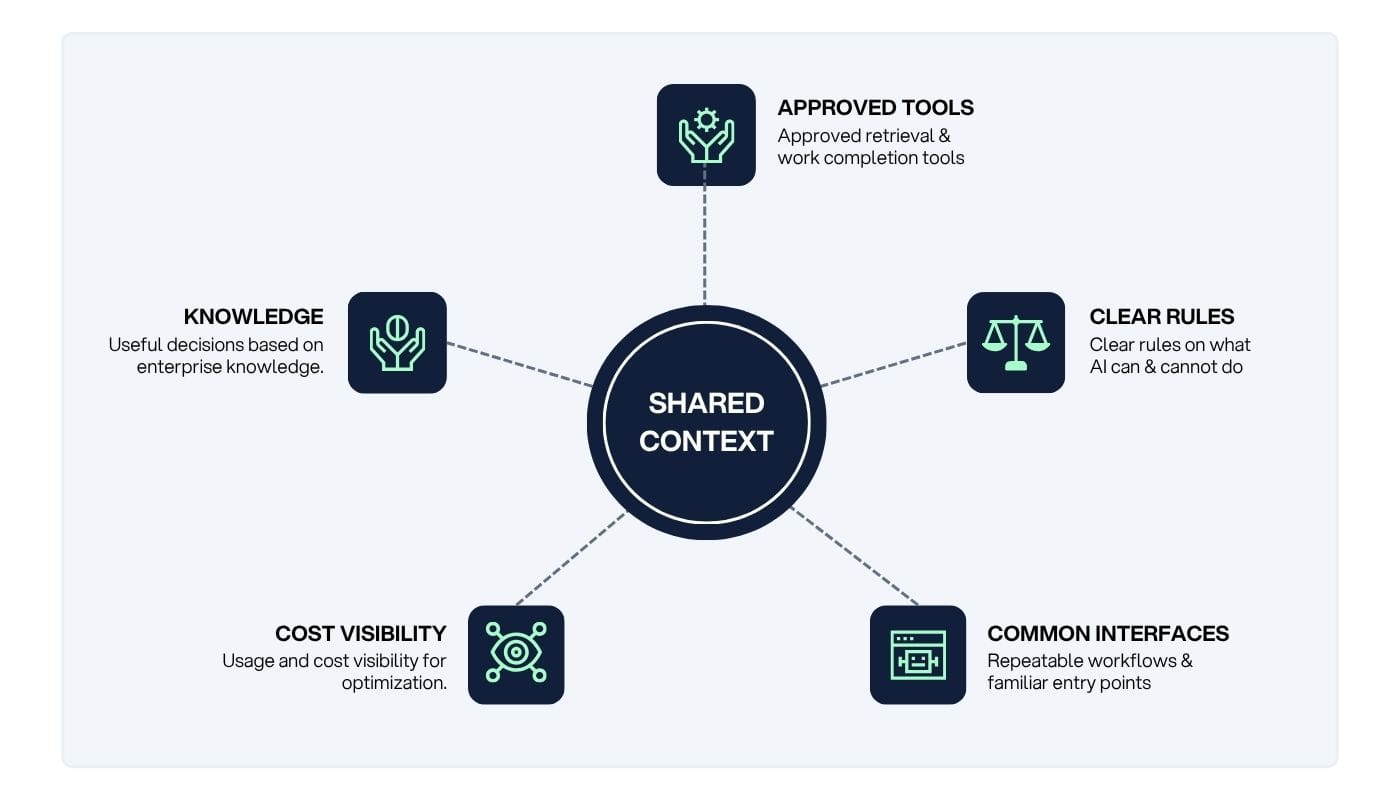
That means more than giving everyone access to the same chatbot. It means creating a shared environment where the right knowledge, tools, rules, and workflows are available to the people and software doing the work.
Shared context can include:
The knowledge the system needs to make a useful decision
Approved tools that let it retrieve information or complete work
Clear rules about what it can and cannot do
Common interfaces that make the workflow repeatable
Visibility into usage and cost
This is the difference between a collection of AI experiments and an enterprise system.
The important context cannot remain scattered across individual laptops, private conversations, and one-off prompts. Some of it has to move into the system itself.
The real gap is between experiments and enterprise systems
The challenge is no longer getting people to try AI. Most organizations have already crossed that threshold.
The harder problem is turning scattered experiments into repeatable systems that produce measurable business value.
A lot of individual usage can look productive while still failing to make the team or the business meaningfully more productive. Employees may each discover a useful workflow, but those workflows are often duplicated, inconsistent, and difficult to support.
The organization ends up with many small islands of productivity instead of one connected capability.
That is the individual-to-enterprise gap.
Many copilots are not the same as one shared agent
Consider two different operating models.
In the first, every employee improvises a workflow in Claude, Copilot, or another general-purpose tool. Each person has a different prompt, a different set of source documents, and a different way of deciding whether the output is trustworthy.
That creates fragmentation.
In the second, employees use a shared agent built around an important business process. The agent has access to the same approved knowledge and tools. The workflow is repeatable. The employee still provides judgment, but the system handles the common work consistently.
That creates leverage.
Individual experimentation is often how the best use cases surface. The goal is to identify which experiments are worth building into shared systems.

Shared context is an enterprise capability
A shared agent is not just a chatbot with better memory.
It is an operating environment for work.
The pieces may sound technical when described as architecture, but In plain terms:
Shared knowledge instead of information trapped in personal workflows
Approved tools (MCP) instead of uncontrolled access to every system
Clear rules instead of individual interpretation
Familiar entry points instead of a different process for every employee
Bespoke user interfaces to drive important workflows and simplify onboarding.
Cost visibility instead of an unpredictable AI bill
This structure matters because AI systems increasingly do more than answer questions. They retrieve information, use tools, make recommendations, and support decisions.
The more consequential the work, the less acceptable it is for the workflow to depend on one person’s prompt-writing ability.
A shared system creates consistency. It also makes the work easier to measure, improve, and support.
Start with the work, not the technology
The move from prompts to systems starts with work, not model selection.
Start with the work.
Find the processes where employees repeatedly gather information, interpret rules, compare options, prepare recommendations, or move data between systems. Look for work that is important, difficult to scale, and structured enough to improve.
Then ask:
Where is the current process slow or inconsistent?
What information does the employee need to assemble?
Which steps are repetitive?
Where does human judgment matter most?
What would a reliable first pass look like?
What should the system never do without a person involved?
This is where AI becomes practical.
The answer is usually not “give everyone a better prompt.” It is “build a shared workflow that gives people a better starting point.”
Organizational implications
The organizational question is not whether AI will change jobs overnight.
Jobs are bundles of tasks. AI usually changes those tasks before it changes the job as a whole.
That gives leaders a more useful place to start.
Transform tasks first. Let roles follow. Begin with measurable tasks where AI can do the initial heavy lifting, like research and analysis. Then move people towards the work that benefits most from human judgement, like relationships and complex decisions. It is safer to change the tasks inside a department before changing the department itself.
While certainly not an exhaustive list, below are some of the tasks and roles AI and humans should respectively assume:

Do not design the org chart first
Leaders often ask whether AI capabilities should be centralized, embedded in business functions, or managed through a hybrid model.
Those are reasonable questions. They are also premature if the organization does not yet understand how the work is changing.
Instead of prescribing the org chart first, observe the workflow.
Build a small number of useful systems. Measure what changes. Look at where new responsibilities emerge, where existing roles become more valuable, and where people need different skills.
One place where this is happening most is software engineering, where frameworks like DORA have long existed to track efficiency. Rather than simply measuring input metrics like the percentage of code generated by AI, mature organizations are measuring output metrics like deployment frequency, lead time for changes, change failure rate, time to restore service. By measuring metrics that are well aligned to ROI, organizations are able to iteratively improve without ambiguity.
With that information, you can begin to inform your organizational model.
Let the organization emerge from evidence
The right sequence is:
Agents mature
Workflow data accumulates
Human responsibilities become clearer
Roles evolve around the work that remains most valuable
This approach is slower than announcing a new structure, but much safer than cutting functions first and figuring out the operating model later.
The organizations that handle AI well will not be the ones that make the boldest predictions about headcount. They will be the ones that understand their work well enough to see which tasks should change, which responsibilities should remain human, and where people can create more value with the right systems around them.

The next phase of agentic AI in the enterprise
The first phase of enterprise AI was about access.
Can employees use the tools? Can they generate a summary, write a draft, analyze a document, or answer a question?
The next phase is about systems.
Can the organization create shared workflows that use the right context, follow the right rules, connect to the right tools, and produce outcomes that can be measured?
That is a different problem.
It requires less fascination with isolated prompts and more attention to the work itself. It requires experimentation, but also a path for turning the best experiments into shared capabilities.
They will have the clearest understanding of where shared context creates leverage.
That is what a happy AI family looks like in practice: not everyone working from a different prompt, but people and systems using the same context to make better work easier and more consistent.
There's a repeatable path from AI pilot to production system.
3-2-1 GO is how phData helps enterprises build shared context and infrastructure.
FAQs
What is agentic AI in the enterprise?
Agentic AI in the enterprise refers to AI systems that don’t just answer questions. They take action like an employee to retrieve information, use tools, follow business rules, and support decisions within defined workflows. Unlike individual chatbot usage, enterprise agentic AI operates from shared context: common knowledge, approved tools, and repeatable processes that make outcomes consistent across teams, not just individuals.
What's the difference between AI copilots and agentic AI systems?
AI copilots assist individual users within a single application. Agentic AI systems operate across workflows, connecting knowledge, tools, and rules that multiple people and processes share. Copilots create individual productivity gains; agentic systems create enterprise-level consistency. The distinction matters because one scales with headcount and the other scales with system design.
Why do enterprise copilots struggle to drive ROI?
Most enterprise AI pilots fail to scale because they optimize for individual usage rather than shared systems. When every employee improvises their own workflow, prompts, and source documents, the organization ends up with fragmented results that are hard to measure, trust, or improve. Scaling requires moving the best workflows into shared agents with common context and governance.
What is shared context in agentic AI?
Shared context in agentic AI is the combination of knowledge, tools, rules, and workflow information that an AI system uses consistently across an organization. It’s the difference between an employee’s private prompt and a governed system that gives everyone the same starting point — accurate information, approved tools, and clear boundaries on what the AI can and can’t do.
How do enterprises get started with agentic AI?
Start with the work, not the technology. Identify processes where employees repeatedly gather information, interpret rules, or move data between systems. Find tasks that are important, repetitive, and structured enough to improve. Build a bounded workflow around one of those processes, measure what changes, and use that evidence to expand — rather than deploying broadly and hoping for adoption.